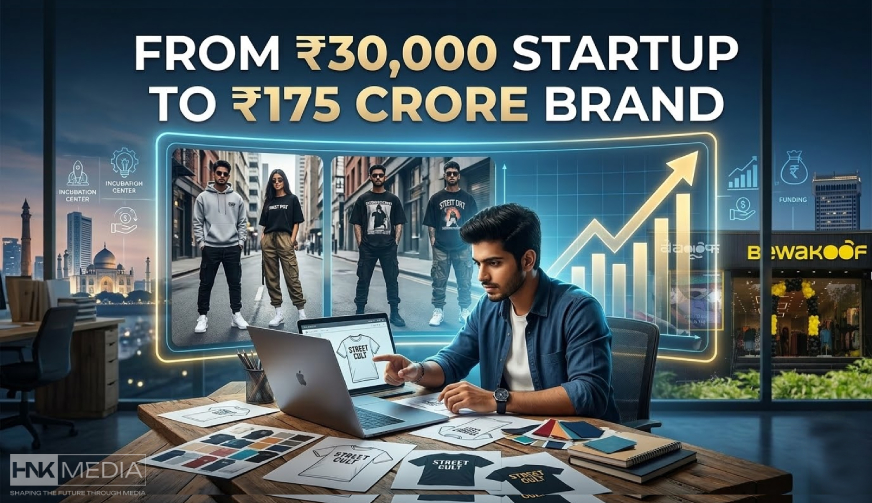
Bewakoof : How a Rs. 30,000 Startup Became India’s Top Youth Fashion Brand
Published on March 16, 2026 by Sanaullah Khan
If you search for Indian D2C fashion success stories, one name appears repeatedly: Bewakoof. What started as a small experiment with quirky printed T-shirts has grown into one of the most recognizable youth fashion brands in India.
Founded in 2012 by Prabhkiran Singh and Siddharth Munot, the brand built a loyal community by mixing humor, pop culture, and affordable fashion. With a starting capital of around ₹30,000, the founders tapped into a huge gap in the Indian market: clothing that young people could relate to.
This case study breaks down Bewakoof’s startup journey, business model, marketing strategy, growth timeline, and lessons entrepreneurs can learn from it.
Quick Facts: Founded 2012 · Rs. 30,000 initial investment · Rs. 175 Cr FY2025 revenue · 10 million+ customers · $39.5 million total funding · 81.77% acquired by Aditya Birla’s TMRW (Feb 2023) · 22 offline stores (Dec 2025)
Bewakoof (legally Bewakoof Brands Private Limited) is an Indian direct-to-consumer (D2C) fashion brand headquartered in Mumbai. Founded in 2012 by IIT Bombay graduates Prabhkiran Singh and Siddharth Munot with an initial capital of Rs. 30,000, the brand sells affordable casual wear — graphic T-shirts, hoodies, joggers, and accessories — primarily targeting Indian consumers aged 16–34. As of FY2025, Bewakoof reports annual revenue of approximately Rs. 175 crore and is now an 81.77% subsidiary of Aditya Birla Fashion and Retail Limited (ABFRL) via its D2C arm, TMRW.
Table of Contents
The Origin Story
Why “Bewakoof” Was a Masterclass in Branding
Bewakoof Business Model Explained
Bewakoof Revenue & Financial History
Bewakoof Marketing Strategy
Funding History
Aditya Birla TMRW Acquisition
Offline Store Expansion
Bewakoof vs Competitors
Key Business Lessons
Future of Bewakoof
FAQs
The Origin Story: A Rs. 30,000 Bet on Quirky Fashion
In 2012, two IIT Bombay engineering graduates looked at India’s youth fashion market and spotted a glaring gap. International brands catered to premium buyers. Traditional Indian labels chased formal or ethnic wear. Nobody was talking to the college student with sarcasm, pop culture references, and Rs. 500 to spend on a T-shirt that actually said something.
Prabhkiran Singh and Siddharth Munot decided to fill that gap. With Rs. 30,000 in savings, a second-hand printer, and what Singh later described as “endless late-night brainstorming sessions,” the duo launched Bewakoof.com on April 1, 2012 — April Fool’s Day. The date was deliberate. The name, which translates from Hindi as “fool” or “foolish,” was equally intentional.
The brand’s founding philosophy was deceptively simple: Life is serious enough. Fashion should be fun.
“I rode my bike across Mumbai pitching to retailers — from Galleria Market in Powai to Heera Panna Mall to Colaba. After months of rejection, I earned a single temporary shelf at one Colaba shop. That experience convinced me the future lay online, not in traditional retail.” — Prabhkiran Singh, CEO, Bewakoof
Their first products were graphic T-shirts with witty Hindi-English slogans and college humour. One early bestseller was the “Ghanta” collection — prints like “Ghanta Engineering” and “Ghanta MBA” — that resonated instantly with students tired of pretending their degrees were glamorous. Word-of-mouth on Facebook began driving consistent traffic to the website, and what started as a side project rapidly became a real business.
The Problem in India’s Fashion Market
Around 2012, India’s fashion market had two extremes.
Premium international brands were expensive, while low-cost clothing brands lacked personality. Young consumers wanted something different: fashion that reflected internet culture, humor, and individuality.
This is exactly where Bewakoof positioned itself.
Instead of serious fashion branding, the company built its identity around fun, sarcasm, memes, and relatable designs.
Even the name “Bewakoof,” meaning “fool,” was chosen intentionally to create a playful brand personality.
Why “Bewakoof” Was a Masterclass in Brand Strategy
Naming your company “Foolish” in a conservative commercial culture is either reckless or genius. For Singh and Munot, it turned out to be the latter. From a strategic branding perspective, the name delivered several advantages that money cannot easily buy.
Branding Advantage
What It Achieved
Instant memorability
No one forgets a brand called “Foolish”
Personality-first positioning
Communicated humour before the customer saw a single product
Gen Z alignment
Young consumers prize brands that don’t take themselves too seriously
Differentiation
No other Indian fashion brand occupied this emotional territory
Built-in content hook
Every meme, caption, and campaign could play off the “bewakoof” concept
The name also gave the marketing team a permanent creative North Star. Every campaign had to be light, irreverent, and self-aware. That consistency transformed the brand from a clothing label into a recognisable persona — something far more durable in a crowded market.
Bewakoof Business Model Explained
Bewakoof operates primarily on a direct-to-consumer (D2C) model — selling products through its own website (bewakoof.com) and mobile app rather than through third-party retailers or marketplace platforms. This model is the foundation of almost every competitive advantage the brand has built.
How Bewakoof Makes Money
Revenue comes from four main streams: direct product sales (apparel accounts for roughly 94% of revenue), brand advertising commissions, subscription services, and increasingly, physical in-store retail sales as the brand expands offline.
Vertical Integration: The Hidden Advantage
Unlike many D2C brands that outsource manufacturing entirely, approximately 80% of Bewakoof’s inventory is produced in-house. This vertical integration gives the company speed to market, quality control, and cost efficiency — critical advantages when the window to capitalise on a cultural moment can be as short as a week.
Why the D2C Model Matters
Better margins: No distributor or retailer markup — competitive pricing without sacrificing profitability
Customer data ownership: First-party data on buying patterns feeds back directly into product design decisions
Repeat purchase engine: Over 60% of orders come from repeat customers, reflecting genuine community loyalty
Speed: Able to test new designs and respond to trends faster than traditional apparel companies
Bewakoof Revenue & Financial History
Bewakoof’s revenue journey reflects the broader challenges of India’s D2C fashion sector — COVID disruption, post-pandemic recovery, and the investment-versus-profitability balance that every scaling startup must navigate.
Financial Year
Revenue
Net Loss
Key Context
FY2020
Rs. 200+ Cr
—
Pre-pandemic peak
FY2021
Rs. 127.7 Cr
~Rs. 20 Cr
COVID-19 disruption; 38% revenue decline
FY2022
Rs. 160.5 Cr
Rs. 80 Cr
Recovery + aggressive expansion spend
FY2023
Rs. 147.1 Cr
Rs. 12.7 Cr
Revenue dip; losses narrowed significantly
FY2024
Rs. 162 Cr
—
Recovery post-TMRW integration
FY2025
Rs. 175 Cr
—
Offline expansion begins; 368 employees
Sources: Entrackr, Tracxn, Startuptalky, Statista. FY = April 1 to March 31.
Profitability note: In FY22, losses surged 4X to Rs. 80 crore on Rs. 160 crore in revenue due to aggressive marketing and headcount expansion. By FY23, losses had narrowed dramatically to Rs. 12.7 crore — signalling meaningfully improved unit economics. With TMRW’s backing, full profitability is the stated near-term target.
Bewakoof Marketing Strategy: Building a Brand Without Traditional Ads
Bewakoof’s marketing strategy is arguably its most studied asset. In an era where D2C brands burn cash on performance advertising, Bewakoof built a loyal community largely through organic content, cultural intelligence, and a highly specific brand voice.
1. Social Media: 6.1 Million Followers Built on Humour
Bewakoof has grown an organic following of over 6.1 million across platforms — approximately 1.6 million on Instagram and 4.5 million on Facebook. The content mix combines product showcases, memes, pop culture references, and moment marketing. Crucially, the brand’s social voice is consistent: irreverent, relatable, and never corporate. This consistency has produced engagement rates that regularly outperform paid campaigns from far larger competitors.
2. Influencer Marketing at Scale
Bewakoof works with over 250 influencers across platforms, with creative freedom to style and present products authentically. Celebrity collaborations have included Rajkummar Rao, Sanya Malhotra, and Sidharth Malhotra as brand ambassadors. The brand also uses micro-influencers to reach Tier II and III city audiences — a segment most premium fashion brands ignore entirely.
3. Moment Marketing and Pop Culture Tie-Ins
One celebrated example: when Marvel released the Avengers: Endgame trailer, Bewakoof launched a “Save the Billionaire” campaign inviting fans to submit ideas to rescue Tony Stark. The campaign generated enormous organic engagement and a measurable spike in branded search — without a large media budget. This ability to move fast on cultural moments is a direct product of its in-house design capability.
4. Regional Language Content
Recognising that young India speaks many languages, Bewakoof produces content in Hindi, Marathi, Bengali, Telugu, and Gujarati. This approach has been a key driver of the brand’s penetration beyond metro cities, opening up the massive Tier II and III consumer base that represents India’s next wave of online shoppers.
5. App-First Strategy: 60 Lakh+ Downloads
With over 60 lakh (6 million) app downloads, Bewakoof has built a direct owned channel that reduces dependence on Amazon or Flipkart. Owning the app means owning the customer relationship — and the ability to send personalised recommendations, targeted offers, and push notifications without paying a platform tax.
6. User-Generated Content (UGC)
The brand actively encourages customers to share their Bewakoof outfits online. UGC campaigns create social proof at zero production cost, reinforce community identity, and generate fresh content that keeps the brand’s social feed feeling real rather than manufactured.
Bewakoof Funding History: $39.5 Million Across 12 Rounds
Bewakoof has raised a total of $39.5 million (approximately Rs. 330 crore) across 12 funding rounds. Key institutional investors include Investcorp, IvyCap Ventures, IndigoEdge, Anicut Capital, and Spring Marketing Capital.
Year
Round
Amount
Key Investor(s)
2011
Angel / Seed
Undisclosed
Early angel investors
2019
Series B
Rs. 80 Cr (~$11M)
Investcorp
2021 (Mar)
Pre-Series B
Rs. 30 Cr
IvyCap Ventures
2021 (Sep)
Pre-Series B ext.
$8.09 Mn
Investcorp-led round
2022–23
Acquisition
Rs. 200 Cr
Aditya Birla TMRW (81.77% stake)
Bewakoof and Aditya Birla TMRW: The Rs. 200 Crore Acquisition
In November 2022, Aditya Birla Group’s D2C venture arm — TMRW (Tomorrow) — announced it was acquiring a controlling stake in Bewakoof for Rs. 200 crore. The deal was formally completed on February 15, 2023, with ABFRL holding 81.77% of Bewakoof Brands Private Limited.
TMRW was purpose-built to create a portfolio of 30 fashion and lifestyle D2C brands. Its current portfolio includes Berrylush, Juneberry, Natilene, Nauti Nati, Nobero, Urbano, and Veirdo. Bewakoof, as the largest and most established brand in the portfolio, is the flagship.
“With Bewakoof’s loyal customer base and our value-add in design, technology, brand building, and supply chain, we aim to scale this brand to Rs. 500 crore plus in the next two years.” — Prashanth Aluru, CEO, TMRW (Economic Times, December 2022)
The strategic rationale was clear on both sides. For TMRW, Bewakoof offered an established community of 10 million+ customers and a proven D2C playbook. For Bewakoof, TMRW brought access to Aditya Birla’s network of over 3,468 stores, 28,585 multi-brand outlets, deep supply chain infrastructure, and the financial firepower to scale aggressively.
India’s casual wear sector — where Bewakoof primarily competes — was estimated at Rs. 14,000 crore at the time and projected to grow at 35–40% CAGR over five years, making the premium paid strategically justified.
Bewakoof’s Offline Expansion: From Zero to 22 Stores in 18 Months
For over a decade, Bewakoof was a purely online brand. That changed in July 2024 when the brand opened its first physical store at Forum Falcon Mall in Bengaluru — a moment CEO Prabhkiran Singh described as deeply personal, referencing his 2011 days riding a bike across Mumbai to pitch to shopkeepers who turned him away.
What followed was one of Indian D2C retail’s most rapid offline scale-ups. After taking nearly a year to open its first 12 stores, Bewakoof dramatically accelerated — opening four new stores in just four weeks by December 2025, bringing the total to 22 locations across Bengaluru, Delhi, Pune, Raipur, Hubli, and other cities.
The stores are designed not merely as sales points but as brand engagement centres — spaces where the Bewakoof personality can be experienced physically. Each follows a standardised playbook for layout, hiring, supply chain management, and pricing, enabling rapid replication.
As Singh noted in a LinkedIn post announcing the expansion, offline retail had evolved from a vanity exercise into a genuine growth engine, feeding back into online performance metrics through improved brand trust and discovery.
Bewakoof vs Competitors: How It Stacks Up in India’s D2C Fashion Market
Brand
Founded
Primary Model
Target Audience
Offline Presence
Bewakoof
2012
D2C (own app + site)
16–34, Tier I–III
22 stores (Dec 2025)
The Souled Store
2013
D2C + marketplace
18–35, fandom merchandise
Growing
SNITCH
2020
D2C (app-first)
18–30, fast fashion men
Expanding rapidly
The Bear House
2016
D2C + marketplace
22–35, premium men’s wear
Limited
NEWME
2022
D2C
16–28, Gen Z women
Minimal ($12M raised Nov 2025)
Per Tracxn (March 2026), Bewakoof ranks #1 among 1,623 active competitors in its segment.
6 Key Business Lessons From the Bewakoof Case Study
1. Brand personality beats budget
Bewakoof built a Rs. 175 crore business largely through organic content and community engagement rather than heavy advertising spend. A strong, consistent brand personality is more durable than any media budget — because it is extremely difficult for competitors to copy.
2. Own your distribution channel
By prioritising its own app and website over Amazon and Flipkart, Bewakoof retained full ownership of customer data and the customer relationship. This enabled 60%+ repeat purchase rates — a metric most marketplace-dependent brands can only dream of.
3. Speed is a competitive advantage in fashion
An in-house design team capable of turning a cultural moment into a sellable product within a week creates differentiation that slow-moving traditional apparel companies simply cannot replicate. Vertical integration made this speed possible.
4. Strategic partnerships accelerate scale at the right moment
The TMRW acquisition at Rs. 200 crore provided infrastructure, supply chain depth, and capital that would have taken years for Bewakoof to build independently. Timing the partnership to a stage where the brand had clear leverage was critical to getting the terms right.
5. Tier II and III cities are India’s real fashion market
By creating regional language content and targeting college students outside metro cities, Bewakoof accessed a consumer segment that most premium and international fashion brands completely ignore. This has driven growth even during periods of metro market saturation.
6. D2C and offline are not opposites — they are multipliers
Bewakoof’s rapid shift to 22 physical stores demonstrates that strong digital-first brands can use offline presence as a growth multiplier — improving brand trust, enabling product discovery for non-digital consumers, and feeding back measurably into online sales metrics.
The Future of Bewakoof: Road to Rs. 500 Crore
As of early 2026, Bewakoof is executing across several growth vectors simultaneously. Revenue reached Rs. 175 crore in FY2025, with 368 employees and a rapidly expanding offline footprint. TMRW CEO Prashanth Aluru has publicly stated the target of scaling Bewakoof to Rs. 500 crore — nearly tripling current revenues.
The pathways to achieve that include aggressive omnichannel retail expansion (opening approximately one store per week), new product category launches including beauty (Cosmos Beauty), teens, and kidswear, deeper technology investment in personalisation and loyalty systems, and potential expansion to serve international Indian diaspora audiences through the app and website.
Market context: India’s online fashion market is projected to reach $43 billion+ and the broader D2C market is expected to become a $300 billion opportunity by 2030 (Inc42). Bewakoof enters this growth phase with 12 years of brand equity, 10 million+ customers, and the infrastructure of Aditya Birla Group behind it — a formidable position.
Frequently Asked Questions About Bewakoof
What is Bewakoof and why is it popular in India?
Bewakoof is an Indian direct-to-consumer (D2C) fashion brand founded in 2012, known for affordable casual wear, graphic T-shirts, and humour-driven branding. It became popular by targeting Gen Z and millennial consumers aged 16–34 through relatable social media content, meme marketing, and pop culture-inspired designs. As of 2025, the brand has served over 10 million customers, amassed 6.1 million social media followers, and holds the #1 rank among 1,623 active competitors in its segment per Tracxn.
Who founded Bewakoof?
Bewakoof was founded in 2012 by Prabhkiran Singh and Siddharth Munot, both engineering graduates from IIT Bombay. Prabhkiran Singh continues as CEO. The brand launched with an initial investment of Rs. 30,000 on April 1, 2012 — April Fool’s Day — a playful nod to the brand name, which means “fool” in Hindi.
What is Bewakoof’s annual revenue?
Bewakoof’s annual revenue as of FY2025 (year ending March 31, 2025) was approximately Rs. 175 crore, according to Tracxn. The brand crossed Rs. 200 crore in FY2020 before the pandemic reduced revenue to Rs. 127 crore in FY2021. Revenue recovered to Rs. 160 crore in FY22 before dipping to Rs. 147 crore in FY23, recovering to Rs. 162 crore in FY24, and growing to Rs. 175 crore in FY25. Total funding raised stands at $39.5 million across 12 rounds.
Did Aditya Birla Group acquire Bewakoof?
Yes. Aditya Birla Fashion and Retail Limited (ABFRL) acquired 81.77% of Bewakoof Brands Private Limited through its D2C arm TMRW. The deal was announced November 28, 2022, and formally completed February 15, 2023, at a total deal value of Rs. 200 crore. Bewakoof is the largest and flagship brand in TMRW’s portfolio of eight D2C fashion labels and is now a step-down subsidiary of ABFRL.
What is Bewakoof’s marketing strategy?
Bewakoof’s marketing strategy centres on humour-driven content, meme marketing, moment marketing, influencer partnerships (250+ influencers), and regional language content targeting Tier II and III cities. Celebrity brand ambassadors have included Rajkummar Rao, Sanya Malhotra, and Sidharth Malhotra. The brand has 6.1 million organic social media followers, over 60 lakh app downloads, and a 60%+ repeat customer rate — all achieved with minimal traditional advertising spend.
Is Bewakoof profitable?
Bewakoof has historically operated at a net loss, common for aggressively scaling D2C brands. In FY22, losses reached Rs. 80 crore on Rs. 160 crore revenue due to heavy marketing and hiring spend. By FY23, losses had narrowed significantly to Rs. 12.7 crore — signalling improved unit economics. With Aditya Birla’s TMRW providing capital and supply chain infrastructure, the brand is actively working toward full profitability as it scales revenue.
Does Bewakoof have offline stores?
Yes. Bewakoof launched its first physical retail store in July 2024 at Forum Falcon Mall in Bengaluru, after more than 12 years as a purely online brand. By December 2025, the brand had expanded to 22 stores across India — in Bengaluru, Delhi, Pune, Raipur, Hubli, and other cities — and is opening approximately one new store per week, marking a major strategic pivot to omnichannel retail.
How does Bewakoof compare to The Souled Store?
Both Bewakoof and The Souled Store are India-based D2C fashion brands targeting young consumers with affordable, culturally-relevant clothing. Bewakoof (founded 2012) is older, larger (Rs. 175 Cr annual revenue), and covers broader casual wear categories. The Souled Store (founded 2013) focuses more heavily on officially licensed fandom and pop culture merchandise. Bewakoof has a larger customer base (10M+) and stronger social media reach (6.1M followers), while The Souled Store leads in licensed IP-based products.
What lessons can entrepreneurs learn from the Bewakoof case study?
The Bewakoof story offers six core lessons: brand personality is a competitive moat that money cannot easily copy; owning your distribution channel (app and website) drives superior customer loyalty; speed to market via vertical integration beats slow traditional apparel players; strategic partnerships accelerate scale at the right moment; Tier II and III cities are India’s largest fashion opportunity; and physical retail can multiply — not contradict — a digital-first brand’s growth trajectory.
Brands Pe Charcha — Bewakoof Marketing Strategy 2025 (November 2025)
CanvasBusinessModel — Bewakoof Brief History & D2C Model Overview
Economic Times — TMRW CEO Prashanth Aluru interview on Bewakoof acquisition (December 2022)
Prabhkiran Singh LinkedIn — Bewakoof first offline store announcement (June 2024)
About this case study: This analysis was researched and written by HNK Media using data from public financial filings, Inc42, Entrackr, Tracxn, and official brand communications. Last updated: March 2026. All financial figures are approximate and sourced from publicly available databases.
4.9(13)· Top rated
Website design service by HNK Media Mumbai was a good decision…Hafiz

 Call 24/7 Hours +91 87677 68614
 Send Us Mail info@hnkmedia.com