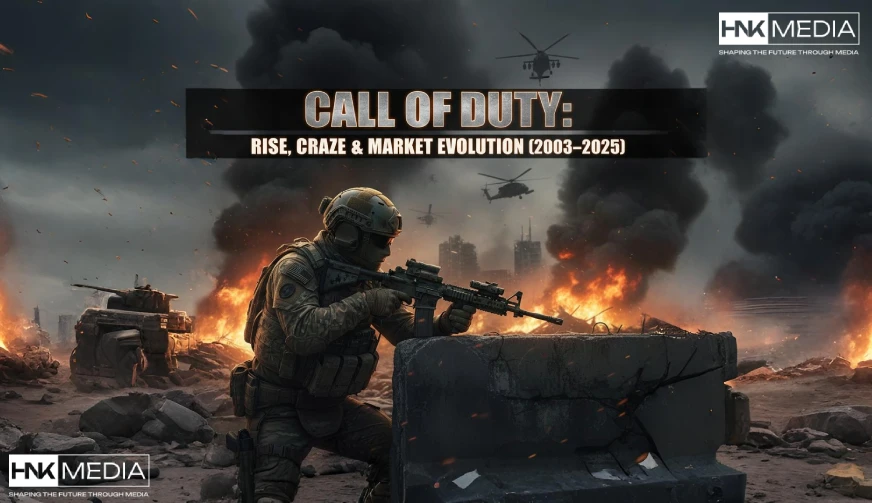
1. Introduction
Few gaming franchises have changed the gaming world like Call of Duty (official site).
What began in 2003 as a simple World War II shooter has become a global entertainment empire — blending storytelling, innovation, and community.
Developed by Infinity Ward and published by Activision, Call of Duty (COD) grew beyond consoles to dominate PC and mobile platforms. It’s not just a game — it’s a cultural phenomenon.
This detailed case study — brought to you by HNK Media — explores the evolution, technology, challenges, and marketing power that made COD one of the highest-grossing gaming franchises in history.
2. The Beginning of Call of Duty (Early 2000s)
In 2003, Infinity Ward, a small team of developers in California, created the first Call of Duty under Activision.
The gaming world already had Medal of Honor, but COD introduced a new experience — more cinematic, realistic, and emotionally powerful.
It focused on teamwork, immersive sound, and historical accuracy. Instead of a superhero soldier, you played as a team member — highlighting war’s chaos and humanity.
COD’s success in 2003 earned Game of the Year awards and set a new benchmark for first-person shooters.
(Source: Wikipedia – Call of Duty)
3. Rise of the Franchise & Shaping the FPS Genre
Activision realized the potential of this hit and expanded COD into a yearly series.
- Call of Duty 2 (2005): Enhanced graphics and larger-scale battles.
- Call of Duty 4: Modern Warfare (2007): Redefined the FPS genre. It introduced modern weapons, cinematic missions, and online multiplayer progression.
- Modern Warfare 2 (2009): Delivered iconic campaigns and unforgettable missions like “No Russian.”
- Black Ops (2010): Added Cold War stories and psychological depth.
By 2012, Call of Duty became a global pop-culture icon, with fan events, merchandise, and a strong multiplayer community.
4. Game Development, Inspiration, and Technology
Behind every great game lies powerful tech and vision.
- Game Engine: Early COD titles used a modified id Tech 3 engine. Later, Activision built the IW Engine — enabling realistic environments and cinematic gameplay.
- Sound & Motion Capture: COD’s use of real weapon audio and actor motion capture made it feel like a movie.
- AI & Multiplayer Systems: The introduction of Killstreaks, Perks, and Loadouts revolutionized multiplayer balance.
- Cross-Platform Play: In 2019, COD became one of the first franchises to allow cross-play between PC, Xbox, and PlayStation.
- Mobile Technology: With Call of Duty: Mobile (2019), the series entered smartphones — optimized for smooth play even on mid-range devices.
Activision’s multi-studio structure — Infinity Ward, Treyarch, Sledgehammer Games, and Raven Software — ensured continuous innovation every year.
5. Business Model and Marketing Mastery
COD’s success isn’t just gaming genius — it’s a marketing case study in itself.
Activision’s model revolved around:
- Annual Releases: Each year brought a new experience, maintaining hype.
- Battle Pass System: Adopted in Warzone and Mobile, keeping players engaged with seasonal content.
- Microtransactions: Cosmetic skins and operator bundles fueled revenue.
- Esports & Influencers: COD became a streaming sensation on Twitch and YouTube Gaming.
- Cinematic Advertising: Campaigns like “There’s a Soldier in All of Us” blended humor and emotion.
The franchise turned players into promoters — a community-driven marketing success that digital brands can learn from.
6. Global Success & Entry into India
COD achieved global domination by blending Western innovation with local appeal.
In India, the mobile version launched in October 2019, attracting millions of downloads within weeks.
After PUBG Mobile was banned, Call of Duty: Mobile became India’s go-to multiplayer shooter.
It provided:
- Console-level graphics on mobile devices.
- Popular modes like Team Deathmatch and Battle Royale.
- Localized content and regional servers.
Esports tournaments such as the Call of Duty Mobile India Cup and local streaming by Indian gaming influencers boosted visibility.
(Source: India Today Tech – COD Mobile India)
7. Community Building & Esports Ecosystem
COD’s player community is its biggest strength.
The Call of Duty League (CDL), launched in 2020, brought structure to global esports.
Franchised city-based teams like Atlanta FaZe and Optic Texas turned gaming into a spectator sport.
In India, teams like GodLike Esports and Team Vitality built loyal fanbases around COD Mobile.
Activision regularly hosted Seasonal Tournaments, Fan Events, and Double XP Weekends — keeping players connected and active.
This community-first strategy can inspire brands to create interactive and emotionally engaging ecosystems, not just one-time campaigns.
8. Competition with PUBG, Battlefield, and Others
COD has always faced fierce competition from PUBG, Battlefield, and Fortnite.
When PUBG popularized battle royale gaming, Activision responded smartly with Call of Duty: Warzone (2020) — a free-to-play battle royale integrating COD’s signature fast-paced action.
Warzone quickly gained 100+ million players, positioning COD as a dominant competitor again.
(Source: GamesRadar – COD Warzone stats)
While Battlefield focused on realism and PUBG on survival, COD balanced arcade fun, realism, and community engagement — keeping it unique.
9. Cultural Impact and Player Psychology
Call of Duty became part of global youth culture — influencing memes, slang, and even teamwork attitudes.
Its multiplayer design triggers dopamine reward loops, motivating replay. But beyond addiction, it fosters coordination, strategic thinking, and social bonding.
The game’s cinematic storytelling also made it emotionally engaging. Missions like “All Ghillied Up” or “Soap and Price’s Journey” are now gaming legends.
10. Challenges, Controversies & Evolution Strategy
COD’s growth also brought challenges:
- Franchise Fatigue: Releasing a game each year risked repetition.
- Cheating Issues: Warzone hackers damaged fair competition until Ricochet Anti-Cheat launched.
- Cultural Criticism: Violence in campaigns sparked ethical debates.
- Corporate Controversies: Activision Blizzard faced workplace issues and lawsuits that temporarily hurt reputation.
Despite this, COD stayed resilient — improving community feedback systems, updating anti-cheat, and continuing major releases like Modern Warfare III (2023).
11. Takeaway for HNK Media & Our Clients
For HNK Media and our partners, the Call of Duty journey offers key lessons:
- Consistency builds brand memory. COD’s annual releases reinforced its identity.
- Adapt to platforms. From consoles to mobiles, COD evolved with user behavior.
- Emotional marketing wins. COD sells not just gameplay but brotherhood and adrenaline.
- Build a community, not just a product. COD’s loyal fanbase fuels its global impact.
- Data-driven personalization. Using analytics for in-game suggestions mirrors how brands can personalize user experiences.
At HNK Media, we use similar principles — data insight, consistency, and creative engagement — to help brands build lasting digital trust.
12. Future of Call of Duty and the FPS Industry
Looking ahead, COD continues to push the boundaries:
- AI-Driven Gameplay: Smarter bots and adaptive storytelling.
- Next-Gen Visuals: Realistic physics with Unreal Engine 5-level visuals.
- Metaverse Integration: Interactive hubs where players can explore digital worlds.
- Mobile Esports Growth: Expanding COD Mobile leagues in India, Southeast Asia, and the Middle East.
COD is also moving toward more inclusive storytelling — adding diverse heroes and emotional depth to its campaigns.
13. Conclusion
From a small 2003 studio game to a multi-billion-dollar empire, Call of Duty is a story of innovation, resilience, and connection.
It proved that success doesn’t come from one hit but from consistent creativity and adaptation.
The franchise’s evolution shows how tech, storytelling, and marketing can blend into one unforgettable global brand.
For gamers, it’s nostalgia.
For creators and marketers, it’s inspiration.
For HNK Media, it’s proof that a clear vision and user-first design create legendary brands.
14. FAQs
1. What is the story behind Call of Duty?
COD began in 2003 by Infinity Ward and grew into a global FPS franchise under Activision.
Read the full Wikipedia article.
2. Who developed Call of Duty?
Infinity Ward, Treyarch, Sledgehammer Games, and Raven Software developed different titles, all under Activision.
3. Is Call of Duty Mobile popular in India?
Yes. Since its 2019 launch, COD Mobile has been one of India’s top-played games, especially after PUBG’s ban.
4. What made Call of Duty successful?
Realistic graphics, addictive multiplayer, continuous updates, and powerful storytelling.
5. What is Call of Duty worth?
By 2025, COD has earned over $30 billion globally, making it one of the world’s top-grossing entertainment franchises.
6. What’s next for Call of Duty?
Activision plans deeper AI integration, cross-platform storytelling, and continued esports expansion.


 Call 24/7 Hours+91 87677 68614
 Send Us Mail info@hnkmedia.com