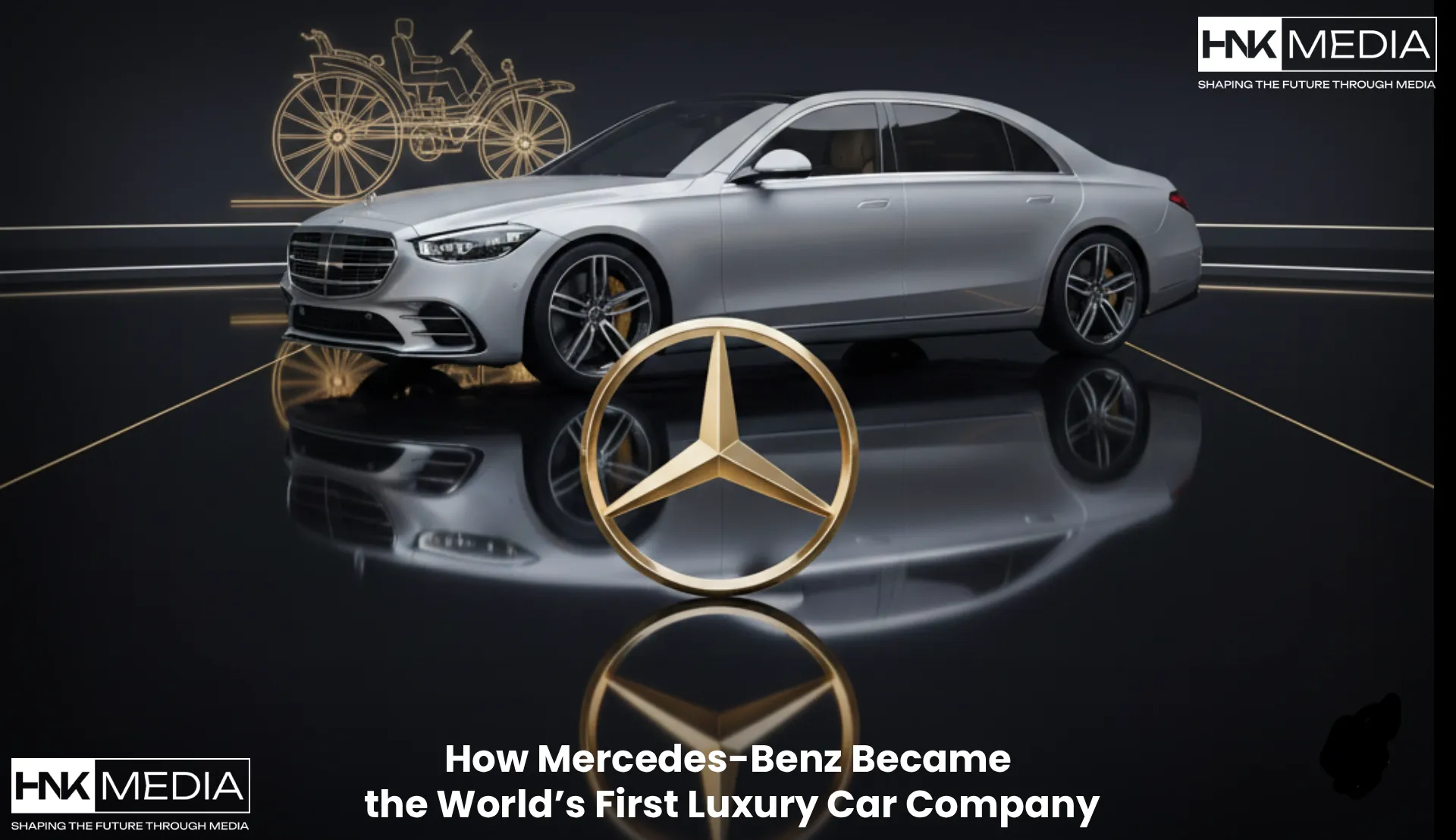
How Mercedes-Benz Became the World’s First Luxury Car Company
Published on December 12, 2025 by sanaullah7867@gmail.com
Introduction — Why Mercedes-Benz Still Defines Luxury in 2025
Mercedes-Benz is more than a car company. It is a symbol of success, engineering excellence, and timeless luxury. Even today, when hundreds of brands compete in the global automobile market, Mercedes continues to stand at the top — not just because of its cars, but because of its vision. The brand treats luxury not as decoration but as a complete experience built on comfort, safety, innovation, and emotional connection.
This case study breaks down how Mercedes-Benz became the world’s first luxury car company, how it built an identity that people trust even after 138+ years, and how the company continues shaping the future of mobility.
Before Mercedes-Benz existed, cars were not premium. They were noisy, unstable, and purely mechanical machines. They were built only to move people from one place to another.
There was no luxury segment, no brand identity, and no emotional value. Customers did not look at cars as lifestyle products. Comfort, safety, design, user experience — none of these existed.
Mercedes-Benz saw this gap early. Instead of building just a vehicle, they built a luxury mobility experience. This decision is what shaped the foundation of the entire premium automotive category.
The User Problem: Comfort, Safety, Prestige Were Missing
When automobiles first entered the market, people had clear problems:
Cars were uncomfortable and shaky
Safety was almost nonexistent
High-income users wanted something premium
No brand offered prestige or status
Driving was difficult and required skill
Mercedes-Benz understood that early users were not only buying transportation — they were buying identity. They wanted a car that made them feel important, safe, and proud.
This is why Mercedes didn’t chase volume in the beginning. They focused on craftsmanship, comfort, and advanced engineering that no one else could match.
The Birth of Mercedes-Benz — The First Luxury Car Company
The story begins in the late 1800s with Karl Benz and Gottlieb Daimler. In 1886, Karl Benz patented the world’s first automobile — the Benz Patent Motorwagen. This invention is considered the birth of the modern car.
A few years later, Daimler and Wilhelm Maybach introduced their own advanced engines, and the brands eventually came together to form Mercedes-Benz.
Why Mercedes Became the First Luxury Car Brand
They built the first reliable petrol-powered car.
They focused on engineering quality rather than cheap production.
Their cars were smoother, more comfortable, and better designed.
Wealthy buyers quickly adopted them as a status symbol.
The brand established “luxury mobility” decades before competitors existed.
The Meaning of the Mercedes Logo
The three-pointed star was introduced in 1909. It symbolized Daimler’s ambition to dominate:
Land
Sea
Air
The circle around the star represents unity and global reach. Over time, the logo became one of the strongest luxury symbols in the world.
How It Became the World’s First Luxury Car Company
Mercedes did something other brands ignored. They made luxury a core product strategy, not an add-on. Their aim was simple: Build the best car in the world — at any cost.
This meant:
Using premium materials
Creating smoother engines
Designing elegant interiors
Making cars safe even before regulations existed
Providing a royal experience to the owner
They solved the status problem, the comfort problem, and the safety problem — all at once.
Business Strategy — How Mercedes Built a Premium Global Brand
Mercedes-Benz positioned itself as a symbol of quality and dignity. Their approach was different from mass manufacturers.
1. Engineering Excellence
Every part of a Mercedes had to feel solid, precise, and reliable.
2. Luxury = Comfort + Safety
Mercedes introduced features like crumple zones, ABS braking, and advanced suspension — decades before mainstream brands.
3. Emotional Branding
Owning a Mercedes became a statement: “You have made it.”
4. Global Identity
The three-pointed star became instantly recognizable worldwide.
Innovation Problem — Industry Focused Only on Mechanics, Not Experience
Most car brands in the early 1900s focused only on mechanical reliability. They ignored the user experience.
But Mercedes understood something early: People don’t just drive a car… they experience it.
So they shifted the industry in a new direction:
Softer seats
Silent cabins
More intuitive controls
Better materials
Improved ride quality
This made Mercedes the leader in human-centered car design, long before UX became a mainstream idea.
Building the Next Generation Car Experience
Mercedes-Benz continues to define future luxury with new technologies.
MBUX — Mercedes-Benz User Experience
AI-powered system
Voice command: “Hey Mercedes”
Personal profiles
Touchscreen navigation
3D displays
Electric Luxury (EQ Line)
Mercedes has shifted to an “Electric First” strategy with models like EQS, EQE, EQA, EQB. These cars use:
Hyperscreen displays
Intelligent battery systems
Quiet electric motors
Futuristic interiors
Autonomous Driving
Mercedes is one of the first companies to get Level 3 autonomous approval in many countries.
Global Luxury Ecosystem — The Power of S-Class, AMG, and Maybach
Mercedes-Benz’s strength comes not only from cars but from a complete luxury ecosystem.
S-Class
The flagship model that sets new standards in automotive innovation.
AMG
Performance division known for powerful engines and sporty design.
Maybach
Ultra-luxury line targeting high-net-worth individuals.
After-Sales Luxury
Their service experience is smooth, premium, and owner-focused.
Staying #1 Despite Competition
The luxury segment is crowded with brands like BMW, Audi, and Tesla. But Mercedes remains the gold standard because of:
Strong heritage
Trust
Innovation
Emotional value
Timeless design
Their strategy combines engineering excellence with premium lifestyle branding.
Brand Identity and Positioning
Mercedes-Benz stands for:
Heritage and quality
Luxury and status
Performance and dignity
Precision engineering
Their tagline “The Best or Nothing” shows their mindset — perfection is the baseline.
Marketing Strategy
Younger Audience Reach
Mercedes successfully attracts Millennials and Gen Z with:
A-Class and CLA
Digital-first campaigns
Social media storytelling
Influencer partnerships
#MBPhotoPass
A popular program where creators showcase Mercedes visually through modern photography.
Sponsorships
Formula 1
Fashion weeks
Global luxury events
These partnerships connect the brand to speed, style, and aspiration.
Key Challenges & Strategic Responses
Challenge
Strategic Response
Aging Customer Base
Sporty compact cars + digital marketing
Competition
Focus on dignity + heavy R&D
Transition to EVs
Electric First strategy
Operational Efficiency
Standardized digital sales systems
Future Outlook
Mercedes-Benz is moving toward:
Electric-only future
MB.OS operating system
Connected services
Circular economy and sustainability
Software-driven cars
Autonomous luxury mobility
The brand aims for CO2 neutrality by 2039, showing long-term global commitment.
Conclusion — The Legacy of the World’s First Luxury Car Brand
Mercedes-Benz did not just build cars. They built a movement. They created a new category: luxury automobiles.
From the first petrol vehicle to AI-powered electric sedans, their journey is defined by bold decisions, human-centered innovation, and a commitment to excellence.
The brand’s success comes from one idea: People don’t buy a Mercedes for transportation. They buy it for the experience.
HNK Media Summary
Mercedes-Benz became a global icon through strong branding, smart positioning, and an unforgettable user experience. At HNK Media, we help businesses build this same level of clarity, identity, and digital impact.
We create brand strategies, websites, and digital experiences that help companies stand out in a competitive market. If you want your brand to feel premium, trusted, and future-ready — we can help you build it.

 Call 24/7 Hours +91 87677 68614
 Send Us Mail info@hnkmedia.com