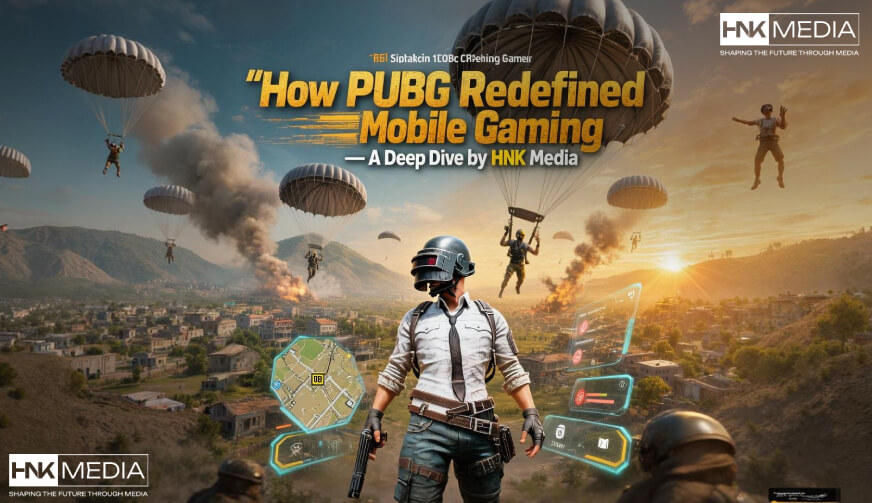
1. Introduction — The Genesis of PUBG
In 2017, South Korean developer PUBG Corporation, originally part of Bluehole Studio, launched PlayerUnknown’s Battlegrounds (PUBG) for PC and consoles. It was the game that brought the “battle-royale” genre into the mainstream. What started as an independent experiment by Brendan “PlayerUnknown” Greene quickly became a worldwide sensation.
The premise was simple yet revolutionary: 100 players parachute onto an island, gather weapons, and fight to be the last one standing. The mix of tactical strategy, survival tension, and open-world gameplay created something the gaming world had never experienced at this scale.
The format—parachute drops, shrinking safe zones, and the adrenaline of being the final survivor—set new standards for multiplayer interaction. Within months, PUBG wasn’t just a game; it became a global digital culture.
2. Global Success & Entry into India
Following its PC and console success, PUBG expanded to mobile platforms through a partnership with Tencent Games. PUBG Mobile officially launched in early 2018 and rapidly captured global attention.
India became one of PUBG’s most important markets. With affordable smartphones, growing internet access, and a massive youth population, mobile-first gaming found its home in India. The game’s accessibility, team-based gameplay, and emotional reward systems resonated deeply with Indian players.
By late 2018, India contributed a significant portion of PUBG’s global downloads, livestreaming viewership, and revenue. Esports tournaments, YouTube streamers, and gaming influencers turned PUBG into a mainstream entertainment phenomenon.
3. Game Development, Inspiration, and Technology
The idea for PUBG came from Brendan Greene’s early mods for games like ARMA 2 and H1Z1. Inspired by Battle Royale and The Hunger Games, Greene imagined a survival arena where only one could win.
PUBG: Battlegrounds was built using Unreal Engine 4, known for its high-fidelity graphics and realistic physics. Remarkably, the mobile version was developed in just four months by Tencent’s Lightspeed & Quantum Studio.
Technology Stack:
- Frontend: Unreal Engine 4, C++, Blueprints, Slate UI Framework
- Backend: AWS GameLift, MySQL, Redis, and UDP networking for low-latency real-time matches
- Optimizations: Scalable graphics, adaptive rendering, and region-based servers for Asia, India, and Europe
This robust stack allowed PUBG to support 100-player matches simultaneously, delivering smooth performance across devices — from flagship phones to entry-level models.
From a development perspective, PUBG proved how good engineering, scalable design, and creative storytelling can coexist in one seamless digital product.
4. UX Design: Interface, Reward Systems & Emotional Loops
At HNK Media, we study successful products to understand how user experience design (UX) drives growth. PUBG’s design is a perfect case of simplicity meeting psychology.
Interface Simplicity
Despite its complexity, PUBG’s UI remains clean and intuitive. Players can quickly access maps, inventory, and health indicators without distraction — vital for the fast-paced environment of mobile play.
Reward Systems
PUBG perfected gamified engagement — daily login bonuses, battle passes, skins, and seasonal rewards. These features created habit loops that kept players returning.
Sound and Immersion
The game’s spatial sound design — footsteps, distant shots, car engines — wasn’t just realistic; it became strategic. Players learned to “hear” danger, heightening emotional involvement.
Emotional Loops
The cycle of “drop → loot → survive → win” fueled adrenaline, victory pride (“Winner Winner Chicken Dinner”), and community bragging rights. This emotional rollercoaster turned casual users into loyal fans.
For UX designers and digital strategists, this shows how clarity, emotion, and reward can work together to build unforgettable digital experiences.
5. User Psychology — Why It Became Addictive and Social
PUBG’s success wasn’t luck — it was built on deep psychological insight.
- Competition: The survival format triggers intrinsic motivation — the need to win.
- Social Connection: Squad modes encouraged collaboration and communication.
- Risk & Reward: Shrinking zones and scarce loot amplified engagement intensity.
- Accessibility: On mobile, it made gaming inclusive, not niche.
- Spectatorship: The thrill of watching others play created a new wave of streamers and esports fans.
These same behavioral triggers are what HNK Media applies in digital marketing — creating shareable, emotionally charged experiences that connect audiences to brands.
6. Ban in India — Data Privacy and Government Restrictions
On 2 September 2020, the Indian government banned PUBG Mobile along with 118 other Chinese-linked apps, citing national security and data privacy concerns.
Reports indicated that user data might be transmitted to foreign servers, violating Indian digital safety standards. The ban disrupted millions of gamers, esports events, and content creators.
For creative firms like HNK Media, this moment highlights a key digital principle — trust and compliance are just as critical as creativity. Brands operating in India must localize not only language but also data governance and privacy frameworks.
7. Rebirth as Battlegrounds Mobile India (BGMI)
Understanding India’s importance, PUBG’s parent company Krafton launched Battlegrounds Mobile India (BGMI) in July 2021 for Android and August 2021 for iOS.
This India-specific version adhered to local data laws, added region-specific content, and positioned itself as “Made for India.” While BGMI faced a temporary suspension in 2022, it was reinstated in 2023 for a trial period under closer government supervision.
This adaptability demonstrates how localization, regulatory alignment, and community engagement are vital for long-term brand sustainability — lessons that HNK Media integrates when building products for diverse Indian audiences.
8. Competitors: Call of Duty Mobile, Free Fire, and Others
PUBG’s success paved the way for competitors like:
- Call of Duty Mobile — offering cinematic visuals and strong nostalgia value.
- Garena Free Fire — optimized for low-end devices, dominating Tier-2 and Tier-3 Indian cities.
Legal disputes followed, as PUBG’s parent company sued Free Fire over gameplay similarities. Still, the healthy competition pushed innovation and diversified the Indian gaming ecosystem.
By 2025, with new genres like Auto-Battlers and Hyper-Casual titles emerging, PUBG’s challenge is to evolve beyond its original mechanics to maintain relevance.
9. 2025 Status: Market Maturity, Esports Rise & UX Lessons
In 2025, PUBG faces a mature market: the initial boom has slowed, but esports and streaming continue to thrive. Krafton is investing millions in Indian esports infrastructure and game development studios.
From a UX perspective:
- Saturation: Users crave novelty; consistent updates are essential.
- Ethical UX: Designers must balance engagement with responsibility.
- Ecosystem Design: Integration with live streaming, social features, and user-generated content keeps experiences fresh.
These lessons go beyond gaming — they apply to any digital experience aiming for longevity and loyalty.
10. UX Lessons — Emotional Triggers vs Ethical Responsibility
PUBG’s emotional hooks are powerful, but they come with responsibility.
At HNK Media, we emphasize ethical design — using engagement strategies responsibly.
- Emotional triggers like achievements, ranks, and visuals drive retention.
- Ethical UX ensures players’ well-being and data safety.
- Localization tailors design to cultural expectations.
- Performance optimization ensures inclusivity across devices — crucial in markets like Mumbai and Maharashtra.
These principles shape how we design websites, apps, and digital experiences — engaging users meaningfully, not manipulatively.
11. Future of Mobile Gaming in India
India’s gaming industry is now a $8 billion opportunity, driven by youth demographics, cheap internet, and the esports boom. Krafton and other global developers are investing over $50 million annually in India to nurture local talent and competitive gaming.
For creative agencies like HNK Media, this represents a shift — from traditional marketing to interactive storytelling. The future belongs to brands that integrate gamification, AR/VR, and immersive design into their digital ecosystems.
Mumbai, as India’s creative hub, is already witnessing this transformation — where gaming meets branding, and design becomes the new entertainment.
12. Takeaway for HNK Media & Our Clients
Global Story, Local Strategy: PUBG proved that global experiences thrive when they respect local markets.
UX + Engagement: Reward systems and social loops are powerful but must balance emotion and responsibility.
Mobile-First Focus: In India, every experience must perform flawlessly on mobile — the same standard HNK Media applies in every website and app we build.
Trust & Compliance: Regulation, privacy, and localization are not obstacles — they’re part of good design.
Evolving Landscape: The next wave of digital experiences will merge gaming, storytelling, and design.
At HNK Media, we take these lessons to heart — crafting digital experiences that engage emotionally, perform flawlessly, and build long-term brand trust.
Google’s Top PUBG Questions — Answered
What does PUBG stand for?
PUBG stands for PlayerUnknown’s Battlegrounds.
Is PUBG now available in India?
Yes. It was relaunched as Battlegrounds Mobile India (BGMI) by Krafton, specifically for the Indian market.
How much money does PUBG make a month?
As of 2023, PUBG Mobile earns an estimated $90–100 million monthly in global revenue.
Why is PUBG banned in India?
The Indian government banned it in 2020 citing data privacy and Chinese ownership concerns.
Who is PUBG’s CEO?
The CEO of PUBG Corporation is Chang Han Kim, under Krafton Inc., South Korea.
Which country plays PUBG the most?
India has one of the largest PUBG user bases, followed by China and the United States.
Is PUBG suitable for a 12-year-old?
Officially, PUBG is rated 16+ due to violence, though BGMI includes parental control features.
What does BGMI stand for?
Battlegrounds Mobile India, the Indian version of PUBG.
Is PUBG an 18+ game?
Yes, in most regions PUBG is classified for ages 16 or 18+, depending on local guidelines.
Is PUBG good or bad?
PUBG can improve reflexes and teamwork but must be played in moderation to avoid addiction.


 Call 24/7 Hours+91 87677 68614
 Send Us Mail info@hnkmedia.com