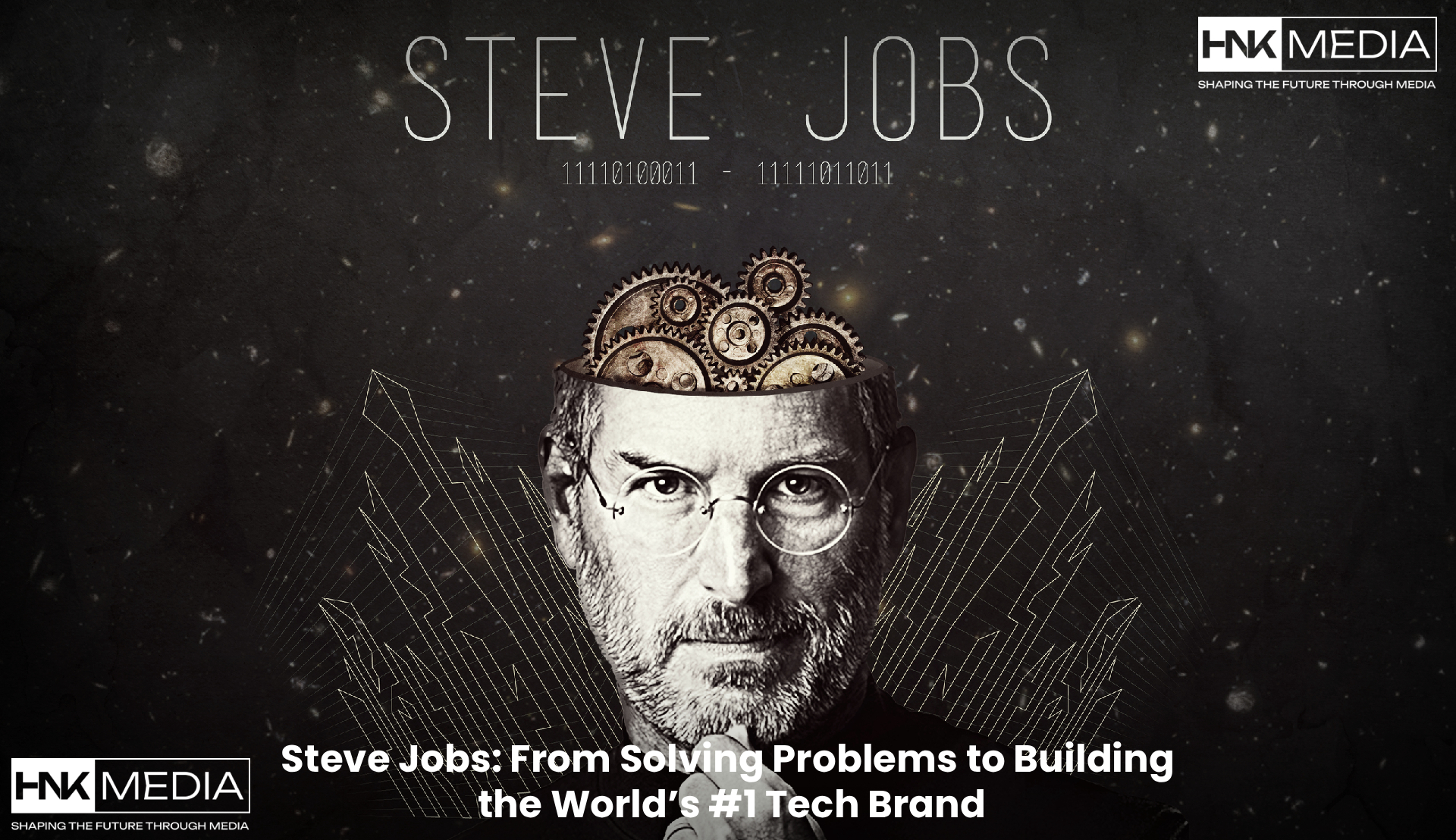
Steve Jobs was more than an entrepreneur. He was a problem-solver who understood people better than most companies understood markets. His journey — from a small garage in California to building Apple into the world’s most valuable tech brand — is a powerful example of how real innovation begins by noticing problems others ignore. Jobs solved market confusion, user frustration, design limitations, and even his own creative challenges. This case study explores the key problems he identified and the bold solutions that shaped the modern digital world.
Throughout this breakdown, you’ll notice how Jobs’ mindset aligns closely with the principles behind branding, digital experience, and UI/UX design — areas we deeply focus on at HNK Media. (Explore our approach: UI/UX Design)
1. How Steve Jobs Solved the Market Confusion of Personal Computers
When Jobs entered the tech scene in the 1970s, personal computers were intimidating machines. They were built for engineers, required technical knowledge, and had no clear purpose for everyday people. Companies like IBM and HP focused on hardware power, not the user experience. The market was full of confusion — people didn’t understand why they needed computers, and businesses didn’t know how to position them.
Jobs saw an opportunity where others saw chaos.
He believed personal computers should be:
- Simple
- Friendly
- Accessible
- Beautiful
- Useful for daily life
This was a radical idea at the time.
Jobs and Steve Wozniak created the Apple I and Apple II to solve this confusion. These computers came pre-assembled, looked clean, and had features regular users could understand. Apple II became one of the first mass-market personal computers. The market suddenly made sense — because Jobs made the computer human.
Outbound Source: Apple’s early product history
https://www.apple.com
This shift from “technology for experts” to “technology for everyone” is the same approach that modern brands follow when designing digital products. In fact, clarity and user understanding remain core principles in website design and development.
Learn how we apply the same philosophy at HNK Media:
Website Design & Development
2. The Problem of “Technology Without Soul” and How Steve Jobs Created Human-Centered Design
Jobs believed most technology lacked emotion. Products were cold, technical, and difficult to use. He wanted technology to feel warm and human — something that felt alive, not mechanical.
This mindset became the foundation of human-centered design, years before it became an industry term.
Jobs focused on making technology:
- Expressive
- Inspiring
- Emotionally engaging
- Easy for anyone
- Designed with empathy
The Macintosh introduced in 1984 guided people with icons, windows, and a mouse — a complete shift from command-based controls. It made technology feel friendly.
He wasn’t just designing machines. He was shaping emotions. The collaboration between design and technology eventually became the DNA of Apple products.
This philosophy aligns closely with how we design brand experiences at HNK Media — where the goal is not just visuals, but emotions, clarity, and connection.
Explore our branding approach:
Branding & Identity
Outbound Source: Steve Jobs Stanford Speech (2005 — human-centric storytelling)
https://news.stanford.edu/2005/06/14/jobs-061505/
3. The Smartphone Problem: How Jobs Simplified a Crowded Market
Before the iPhone, smartphones were complicated devices. They had many buttons, small screens, confusing menus, and weak internet experiences. Companies competed by adding more features without improving usability. Users struggled to understand their own devices.
Jobs studied the market and saw one core problem:
Smartphones did everything, but nothing well.
The solution was simplicity. He removed the physical keyboard and replaced it with a full multi-touch screen. Instead of adding more buttons, he eliminated them.
The iPhone became:
- A phone
- A music player
- A camera
- A web device
- A digital ecosystem
all in one small, intuitive rectangle.
This wasn’t just a new phone. It replaced the idea of a phone itself.
Today, entire categories like mobile apps, UI patterns, and digital ecosystems exist because of that one decision.
If you look at how we design mobile apps and digital products today, the same principles live on — clarity, simplicity, and fluid experience.
Learn more:
UI/UX Design Services
4. How Steve Jobs Built Apple by Solving His Own Creative Problems
A fascinating part of Jobs’ journey is how many of his innovations came from solving his own frustrations. Jobs disliked cluttered interfaces, slow performance, and products that didn’t feel elegant. He believed that if something didn’t satisfy him personally, it wouldn’t satisfy anyone.
This personal obsession shaped Apple’s creative standards:
- Quick response times
- Smooth animations
- High-quality materials
- Minimalistic interfaces
- Seamless user experience
Jobs built Apple not by copying trends, but by building the products he wished existed. He solved his own creative challenges — and millions of people felt the same pain points.
This is the same approach we use in experience design at HNK Media: solve real problems, simplify complexity, and design with purpose.
5. Digital Experience Problem: Jobs’ Vision of an Integrated Ecosystem
One of Jobs’ biggest insights was recognizing the fragmentation in digital experiences. Devices didn’t talk to each other. Software felt disconnected. Companies built products separately without considering how users move between them.
Jobs solved this by creating a unified ecosystem:
- iPhone
- iPad
- iMac
- MacBook
- iPod
- App Store
- iTunes
- iCloud
Everything worked together. If you owned one Apple device, you automatically enjoyed the benefits of owning others.
This seamless experience became Apple’s biggest competitive advantage.
The idea of creating a connected ecosystem is also essential in modern business — from brand identity to website design to digital marketing. A disconnected brand confuses people, just like disconnected devices frustrate users.
Explore how we build integrated digital identities for brands:
Branding & Identity
Outbound Source: Harvard Business Review — Leadership & Innovation
https://hbr.org
6. From Garage to Global: How Steve Jobs Built the World’s #1 Tech Brand
Steve Jobs didn’t start with funding, resources, or a clear roadmap. He started in a garage with passion for solving problems. Apple grew because each product fixed a broken experience:
- Apple I → A computer regular people could assemble
- Apple II → A friendly home computer
- Macintosh → A computer with personality
- iMac → A return to simplicity
- iPod → Solved music portability
- iPhone → Simplified smartphones
- iPad → Created a new digital content category
His clarity of purpose created clarity in products.
From being fired at Apple to returning and saving the company from collapse, Jobs proved that innovation isn’t just building new things — it’s about solving old problems better.
His journey reflects the same principle we share with clients at HNK Media:
great digital experiences come from solving real user problems.
See how we help businesses grow through problem-focused strategies:
SEO & Digital Growth
Conclusion
Steve Jobs built Apple by focusing on problems that others ignored: confusing markets, unfriendly technology, fragmented ecosystems, and products without emotion. His journey shows how much impact one person can create when they combine vision with deep understanding of users.
From a garage startup to the world’s #1 tech brand, his story is a masterclass in innovation, leadership, and human-centered design. His solutions inspired a new era of digital experience — one that continues to guide how companies build products, design interfaces, and shape technology.
If you’re building a business, designing a product, or shaping a brand, Jobs’ mindset is the best guide:
Start with problems. Solve them with clarity. Design with emotion.
If you want help crafting brand, website, or digital experiences that follow this philosophy, explore our services or reach out to our team:
Contact HNK Media


 Call 24/7 Hours+91 87677 68614
 Send Us Mail info@hnkmedia.com