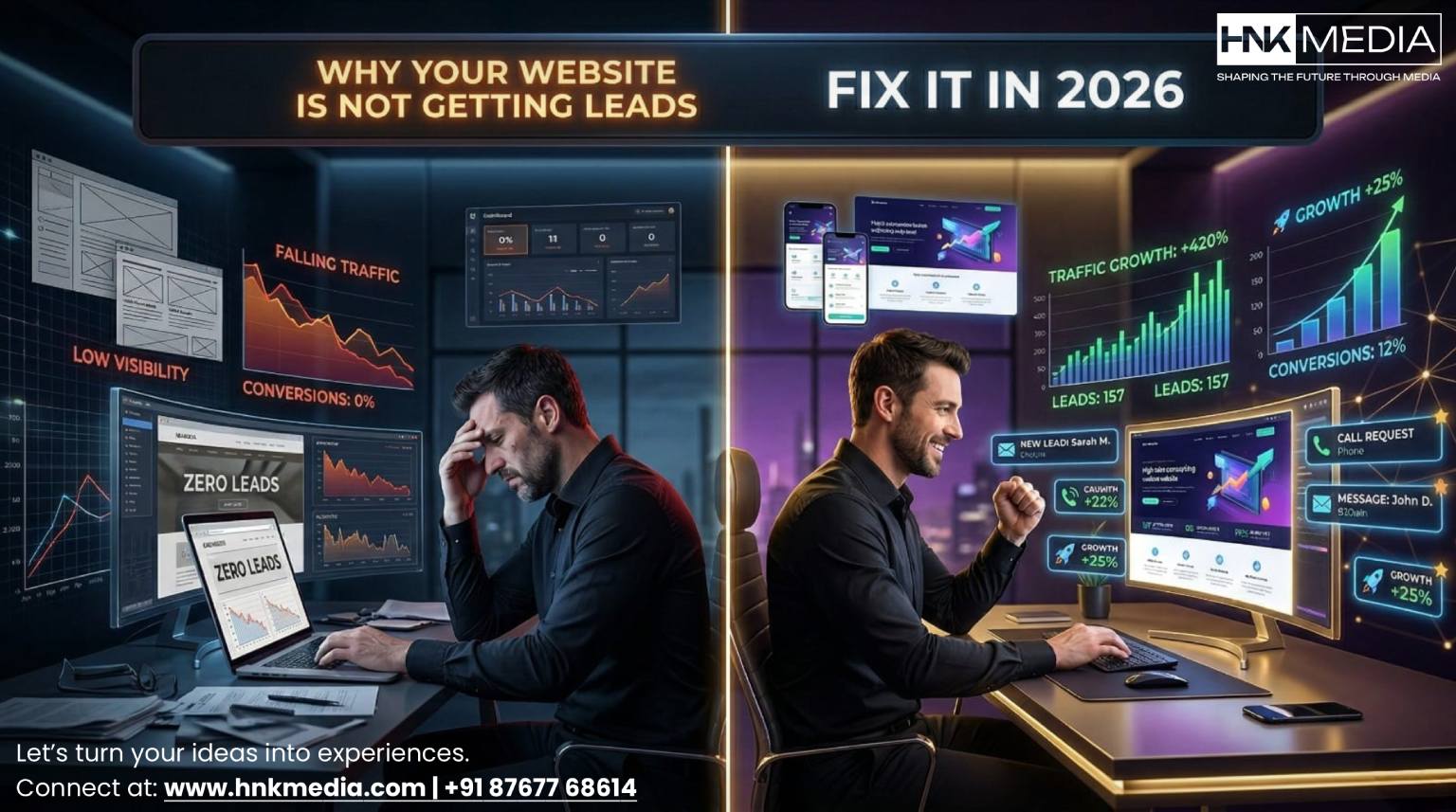
Why Your Website Is Not Getting Leads | Fix It in 2026 | HNK Media
Published on March 23, 2026 by sanaullah7867@gmail.com
Introduction :You Have Traffic — But Your Phone Isn’t Ringing
You have invested in a beautiful website. At the same time, you are running ads to bring traffic. In addition, your social media presence is active and consistent. Your Google Analytics shows visitors coming in every single day. And yet — the phone is silent. The inquiry form is empty. Your business is not growing the way it should.
Sound familiar? You are not alone.
Thousands of businesses across India — from startups in Andheri to established brands across Mumbai — face this exact frustration. They pour budgets into digital marketing and website development but fail to see the one thing that actually matters: leads.
The hard truth? Most websites are glorified digital brochures. They look nice, but they are not engineered to convert.
At HNK Media, we audit hundreds of websites every year — and the same critical mistakes appear again and again. In this guide, we are going to break down every single reason your website is not getting leads in 2026 — and, more importantly, exactly what to do about each one.
💡 Quick Stat The average website conversion rate globally is just 2.9%. That means for every 100 visitors, fewer than 3 take action. But with the right optimization, this number can be pushed to 8–12% or higher.
Reason #1: You Are Targeting the Wrong Keywords
This is one of the most common and costly mistakes businesses make. You may be ranking on Google — but for the wrong type of search.
In 2026, there are four types of search intent:
Informational — User wants to learn (e.g., ‘what is digital marketing’)
Navigational — User is looking for a specific brand or page
Commercial — User is comparing options (e.g., ‘best digital marketing agency Mumbai’)
Transactional — User is ready to act (e.g., ‘hire digital marketing agency Mumbai’)
Most websites unknowingly target only informational keywords. These attract curious readers, not paying customers. If 90% of your traffic comes from informational intent, you will have great numbers in Analytics and zero leads in your inbox.
The Fix: Target High-Intent, Buyer-Ready Keywords
Shift your strategy to focus heavily on commercial and transactional keywords. Examples for a digital agency in Mumbai:
‘best digital marketing agency in Mumbai’ (Commercial)
‘hire SEO company Mumbai’ (Transactional)
‘website development company Andheri’ (Transactional)
‘branding agency Mumbai for startups’ (Commercial)
Use tools like Google Search Console, Ahrefs, and Semrush to find which keywords are already bringing traffic — and identify which ones have actual purchase or inquiry intent.
🔥 HNK Media Tip Map every page of your website to a specific search intent. Your homepage and service pages must target transactional and commercial keywords. Save informational keywords for your blog content, and always include a strong CTA even inside blog posts.
Reason #2: Your Website Has No Clear Call-To-Action (CTA)
Imagine walking into a beautiful store with great products — but there are no price tags, no staff, no signage, and no billing counter. You would leave confused.
That is exactly what happens when visitors land on a website with no clear Call-To-Action.
A CTA is the bridge between a passive visitor and an active lead. Without a strong, visible, and specific CTA on every key page, you are relying on visitors to telepathically know what to do next — and they will not. They will simply leave.
Common CTA Mistakes to Avoid
Generic CTAs like ‘Click Here’ or ‘Submit’ that communicate no value
Burying the CTA below the fold where users never scroll to find it
Using too many CTAs on one page, creating confusion and decision fatigue
CTA buttons that blend into the background with poor colour contrast
Having no CTA on blog posts or informational pages
The Fix: One Clear, Benefit-Driven CTA Per Page
Replace generic CTAs with specific, value-oriented language:
Instead of ‘Contact Us’ → Use ‘Get a Free Website Audit’
Instead of ‘Submit’ → Use ‘Send Me My Free Quote’
Instead of ‘Learn More’ → Use ‘See How We Grew This Brand by 300%’
Place your primary CTA above the fold (visible without scrolling), repeat it after key sections like testimonials and case studies, and make it visually distinct with your brand’s accent colour.
💡 CTA Placement Best Practice (2026) According to CRO research, placing CTAs after testimonial sections increases conversion rates significantly. User gains trust — then immediately sees the next action. This sequencing of trust → action is the most effective conversion pattern in 2026.
Reason #3: Poor Website UX and Navigation
User Experience (UX) is no longer just a design principle — it is a business-critical conversion factor. If visitors cannot find what they are looking for within 3–5 seconds, they leave. And they rarely come back.
Google’s algorithms have also evolved to reward websites that deliver exceptional user experiences. High bounce rates and low dwell times signal to Google that your site is not satisfying search intent — which hurts your rankings and reduces your lead flow further.
The Most Common UX Problems That Kill Leads
Cluttered homepage with too much information, too many options, and no clear hierarchy
Navigation menus that are confusing or have too many nested dropdowns
Slow page load speed — pages that take more than 3 seconds to load lose up to 53% of mobile visitors
No visual hierarchy — visitors cannot identify what is most important on the page
Pop-ups and interstitials that block content immediately on arrival
Broken links, 404 errors, and outdated content that destroys credibility
The Fix: Design for Your Visitor’s Journey, Not Your Preferences
Audit your website from a visitor’s perspective. Ask yourself:
Can a new visitor understand what we do within 5 seconds of landing on the homepage?
Is the path from homepage → service page → contact clear and frictionless?
Does every page answer the visitor’s question and provide a logical next step?
Is our website fast, responsive, and usable on a mobile device?
Use tools like Google PageSpeed Insights, Hotjar (heatmaps), and Microsoft Clarity to see exactly how real users are interacting with your site — and where they are dropping off.
🔥 Speed is Non-Negotiable in 2026 Aim for a Largest Contentful Paint (LCP) of under 2.5 seconds on mobile. Every additional second of load time reduces conversions by an estimated 7%. Compress images, minimize scripts, and use a reliable hosting provider with Indian data centres for Mumbai-based businesses.
Reason #4: Your Website Lacks Trust Signals
Visitors make trust decisions within seconds of landing on your page. No matter how beautiful your design is, if your website lacks credibility markers, visitors will hesitate — and hesitation kills conversions.
Think about it from your customer’s perspective: they are about to share their contact information, schedule a call, or even spend money with you. The first question running through their mind is: ‘Can I trust this business?’
If your website cannot answer that question convincingly within seconds, you have lost the lead.
Essential Trust Signals Every Business Website Must Have
Client Testimonials — Real quotes with names, photos, and company names (not just anonymous reviews)
Case Studies — Before-and-after stories with real numbers and measurable outcomes
Client Logos — Displaying recognizable brand logos you have worked with builds instant credibility
Awards & Certifications — Industry recognition, Google Partner status, or platform certifications
Google Reviews — Display your star rating prominently, ideally on the homepage
Team Photos & Bios — Real faces build human connection and trust
SSL Certificate (HTTPS) — Non-negotiable; visitors are warned by browsers about insecure sites
Privacy Policy & Terms — Signals that you are a legitimate, transparent business
Media Mentions — Press coverage or features in publications add significant authority
The Fix: Build a Trust-First Website Architecture
Every high-intent page — your homepage, service pages, and contact page — must contain at minimum three trust signals. Your contact page, where conversion is the sole purpose, should have the highest density of social proof on your entire website.
💡 Real Numbers Matter Generic testimonials like ‘Great service! Highly recommend’ convert far less than specific, outcome-driven testimonials such as ‘HNK Media redesigned our website and we went from 2 leads per month to 34 leads per month in 90 days.’ Specificity = credibility.
Reason #5: Your Website Is Not Mobile-Optimised
In India, over 78% of all internet traffic comes from mobile devices. In Mumbai specifically, the overwhelming majority of your potential clients are browsing your website on their smartphones — often on the go, with limited patience.
If your website is not built with a mobile-first approach, you are effectively turning away the majority of your visitors before they even read your message.
Signs Your Website Is Failing Mobile Users
Text is too small to read without zooming
Buttons are too close together and difficult to tap accurately
Forms are hard to fill out on a small screen
Images overflow the screen width
Pop-ups do not close properly on mobile
The mobile version looks completely different from the desktop version
The Fix: Adopt a Mobile-First Design Philosophy
Mobile-first design means you design for the smallest screen first and then scale up. In other words, you do not start with desktop and adjust later. Instead, you build the experience for mobile users from the beginning.
Therefore, every element, button, form, and CTA must be tested carefully. In addition, each part should be optimised specifically for mobile users. As a result, your website becomes easier to use and improves conversions.
Run a free Mobile-Friendly Test on Google Search Console. Any issues flagged there are direct barriers to lead generation from your mobile audience.
Reason #6: You Are Attracting the Wrong Audience
High traffic means nothing if the people visiting your website have no intention of becoming your customers. In fact, this is one of the most misleading metrics in digital marketing. Sometimes, a website can have thousands of monthly visitors and still generate zero qualified leads.
In many cases, this problem happens because your content or ads attract the wrong audience. For example, you may be targeting informational keywords instead of buyer-intent searches. As a result, users visit your website but are not ready to take action.
In addition, paid ads may target broad audiences outside your ideal location or industry. Because of this, your traffic increases, but conversions remain low. At the same time, your budget may also get wasted.
Some common signs include a high bounce rate on landing pages. Also, users may not visit your service pages. Furthermore, many visitors do not open your contact form. Even if they spend time on your site, they may not take any action.
Therefore, it is important to align your SEO strategy, ad targeting, and content with your ideal customer profile. Only then will your traffic turn into qualified leads.
The Fix: Align Your Traffic Sources with Buyer Intent
Audit your Google Analytics or GA4 to understand who is actually visiting your site. Look for:
Geographic data — Are visitors from your target city or region?
Behaviour flow — Are visitors navigating to service pages or bouncing from the homepage?
Acquisition source — Is organic traffic coming from relevant, high-intent keywords?
Demographics — Do your visitors match your ideal customer profile?
If you are running paid advertising, tighten your audience targeting. Use custom audiences, detailed demographic filters, and geographic restrictions to ensure only qualified prospects see your ads. Quality of traffic always beats quantity.
🔥 The Right Traffic vs. The Wrong Traffic A website with 1,000 highly targeted visitors per month will consistently outperform a website with 50,000 random visitors in lead generation. Focus your SEO and content strategy on intent-matched traffic — people who are actively looking for what you sell.
Reason #7: Your Messaging Is Vague and Customer-Unaware
When someone lands on your homepage, you have approximately 3 to 5 seconds to answer one critical question in their mind: ‘What is in this for me?’
Most business websites fail this test immediately. Headlines like ‘Welcome to ABC Company’ or ‘Your Trusted Partner Since 2010’ are self-focused and tell the visitor nothing about how you solve their problem.
Your potential customer is not interested in your company’s history in those first few seconds. They are interested in one thing: whether you can solve their problem better than anyone else.
The Fix: Write for Your Customer, Not for Yourself
Restructure your messaging with this framework:
Problem Statement — Acknowledge the visitor’s pain point in the headline
Solution Promise — Clearly state what you do and who you do it for
Proof — Back it up with a quick stat, number of clients, or notable result
Action — Direct them to the next step with a clear CTA
Example for a digital agency: Instead of ‘We Are a Full-Service Digital Agency in Mumbai’ → Try ‘Struggling to Get Leads Online? We Build Websites & Digital Strategies That Actually Convert — Trusted by 200+ Mumbai Businesses.’
The second version speaks directly to the visitor’s pain, establishes authority, and creates trust instantly.
Reason #8: You Have No Lead Capture Strategy
Most websites present visitors with only one option: fill out a contact form and wait. But the reality of buyer behaviour in 2026 is that most visitors are not ready to commit on their first visit. They are researching, comparing, and evaluating.
If you do not capture them at the research stage, they will find a competitor who does.
Build a Multi-Touch Lead Capture System
An effective lead capture strategy offers multiple entry points based on where the visitor is in their buying journey:
Lead Magnets — Free guides, audits, templates, or checklists that visitors download in exchange for their email address
WhatsApp Chat Integration — In India, WhatsApp is the most preferred communication channel; a WhatsApp button dramatically reduces friction for inquiries
Free Consultation CTAs — Lower-risk offers that encourage hesitant visitors to take a first step
Exit-Intent Popups — Triggered when a visitor is about to leave; offer something valuable to retain them
Newsletter Opt-In — Build an email list and nurture subscribers into leads over time
Chatbots — AI-powered chat that qualifies leads even when your team is offline
💡 WhatsApp is India’s #1 Lead Channel For businesses targeting Indian clients, integrating a WhatsApp direct chat button on your website can increase inquiry rates by 30–60%. Indian customers are significantly more likely to send a WhatsApp message than fill out a formal contact form. Do not ignore this channel.
Reason #9: Your Technical SEO Is Broken
You can have the best content, the strongest branding, and the most compelling CTAs — but if Google cannot crawl and index your website properly, none of it matters. Technical SEO issues silently kill your visibility and, consequently, your lead flow.
Critical Technical SEO Issues That Block Leads
Slow Core Web Vitals (LCP, FID, CLS) — Google uses these as ranking signals in 2026
Missing or duplicate meta titles and descriptions — Confuses search engines and reduces click-through rates
Broken internal links and 404 pages — Wastes crawl budget and frustrates users
No XML sitemap submitted to Google Search Console
Duplicate content across multiple pages — Dilutes your ranking authority
Images without alt text — Misses both SEO and accessibility requirements
Schema markup missing — Reduces your chances of appearing in rich results and AI Overviews
Non-canonical URLs causing index bloat
The Fix: Conduct a Full Technical SEO Audit
Use tools like Google Search Console (free), Screaming Frog, or Ahrefs Site Audit to identify and fix these issues systematically. Prioritise fixes that impact crawlability and user experience first.
In 2026, Google’s AI-powered systems are better than ever at detecting thin content, intent mismatches, and poor technical health. Only websites that score well on all three dimensions will earn consistent organic visibility.
Reason #10: Your Content Does Not Match the Buyer’s Journey
Content is not just about ranking on Google — it is about guiding your visitor through a carefully crafted journey from stranger to lead to customer. Most websites publish content without any strategic structure, resulting in blog posts that attract readers but never convert them.
The Three Stages of the Buyer’s Journey
Awareness Stage (Top of Funnel) — Visitor is identifying a problem. Content: Blog posts, infographics, explainer videos. Example: ‘Why is my website not getting traffic?’
Consideration Stage (Middle of Funnel) — Visitor is evaluating solutions. Content: Case studies, comparison guides, webinars. Example: ‘Digital marketing agency vs. in-house team — which is better?’
Decision Stage (Bottom of Funnel) — Visitor is ready to hire or buy. Content: Testimonials, service pages, free audits, pricing pages. Example: ‘Best digital marketing agency in Mumbai — why choose HNK Media‘
If all your content targets the awareness stage, you are educating your visitors and sending them to competitors when they are ready to buy. Ensure you have strong content — and strong CTAs — at every stage of the funnel.
🔥 Content Architecture = Lead Architecture Think of your website’s content structure like a funnel. Blog posts attract visitors. Service pages and case studies build consideration. Contact pages and lead magnets convert. Every piece of content must have a purpose and a path to the next stage.
Bonus Reason: You Are Not Measuring the Right Metrics
If you are measuring success by page views and sessions alone, you will never understand why your website is not generating leads. Vanity metrics look impressive in reports but tell you nothing about revenue.
The Metrics That Actually Matter for Lead Generation
Conversion Rate — Percentage of visitors who take a desired action (form fill, call, WhatsApp message)
Cost Per Lead (CPL) — How much it costs to acquire each lead across all channels
Lead Quality Score — Are the leads coming in actually qualified for your service?
Bounce Rate by Page — Which specific pages are losing visitors, and why?
Form Abandonment Rate — How many visitors start filling your form but do not submit?
Session-to-Lead Rate — The ratio of sessions to actual inquiries generated
Set up GA4 with conversion goals, integrate your contact forms with your CRM, and create a simple weekly dashboard that tracks lead volume, source, and quality. Data-driven decisions are the difference between guessing and growing.
✅ The Complete Lead Generation Fix Checklist for 2026
Use this checklist to audit your website right now. Every ‘No’ is a lead generation opportunity:
#
Checklist Item
Status
1
Service pages target transactional/commercial keywords
☐ Yes / No
2
Homepage headline is customer-focused, not company-focused
☐ Yes / No
3
Every key page has one clear, benefit-driven CTA above the fold
☐ Yes / No
4
Website loads in under 2.5 seconds on mobile (LCP test passed)
☐ Yes / No
5
Website is fully responsive and mobile-first
☐ Yes / No
6
At least 3 trust signals on homepage (reviews, logos, testimonials)
☐ Yes / No
7
Case studies with real numbers are published and linked from service pages
☐ Yes / No
8
WhatsApp chat button is active and visible on all pages
☐ Yes / No
9
Lead magnet or free audit offer is prominently available
☐ Yes / No
10
No broken links or 404 errors on key pages
☐ Yes / No
11
Meta titles and descriptions are unique on every page
☐ Yes / No
12
XML sitemap submitted to Google Search Console
☐ Yes / No
13
Schema markup implemented on homepage, service pages, and blog
☐ Yes / No
14
Contact form is short (max 4 fields) and tested on mobile
☐ Yes / No
15
GA4 conversion goals are configured and tracking accurately
☐ Yes / No
16
Content strategy covers all 3 stages of the buyer’s journey
☐ Yes / No
17
Exit-intent popup or newsletter opt-in is active
☐ Yes / No
18
SSL certificate is active and all pages load on HTTPS
☐ Yes / No
19
Competitor keywords are identified and service pages optimised for them
☐ Yes / No
20
Weekly lead tracking dashboard is in place and reviewed by the team
☐ Yes / No
❓ Frequently Asked Questions (FAQ)
These FAQ entries are optimised for Google’s “People Also Ask” and AI Overview features for better SERP visibility.
Q1: Why is my website getting traffic but no leads?
If your website has traffic but no leads, then the issue usually lies in a few key areas. For example, your keywords may be attracting the wrong audience, your CTAs might be weak or missing, or your website may lack trust signals. In addition, a poor landing page experience can reduce conversions.
Therefore, the best solution is a structured Conversion Rate Optimisation (CRO) audit. This helps you identify exactly where visitors are dropping off and then fix each problem step by step.
Q2: How long does it take for a website to start generating leads?
With the right technical SEO, content, and conversion optimisation in place, most websites start seeing results within 3 to 6 months. However, this depends on competition and consistency.
In contrast, paid advertising can bring faster results. At the same time, organic lead generation takes longer but gives more stable growth over 6 to 12 months. Therefore, businesses that invest early will have a strong advantage in the long run.
Q3: What is a good website conversion rate for lead generation?
The average website conversion rate is around 2.9% globally. However, this number can vary depending on your industry and traffic quality.
For example, B2B service websites should aim for 3% to 5% conversion rates. Meanwhile, focused landing pages, especially for ads, can reach 5% to 10% with proper optimisation. So, improving CTAs, trust signals, and messaging can directly increase conversions.
Q4: Do I need to redesign my entire website to get more leads?
Not necessarily. In most cases, the problem comes from small but important issues like weak CTAs, unclear messaging, or slow page speed.
For instance, improving CTA placement, adding trust signals, and simplifying forms can give quick results. Therefore, a CRO audit helps you fix high-impact issues without a full redesign. However, if your website has major structural problems, then a redesign may be the better long-term solution.
Q5: Does having a blog help generate more leads?
Yes, but only when done strategically. In other words, your blog must match your buyer’s journey.
For example, targeting high-intent keywords brings visitors who are ready to take action. In addition, every blog should include internal links to service pages and clear CTAs. Otherwise, blogs may bring traffic but not leads.
Q6: How important is mobile optimisation for lead generation in India?
Mobile optimisation is extremely important. In fact, more than 78% of internet users in India access websites through mobile devices.
Therefore, your website must be mobile-first, fast, and easy to use. For example, buttons should be easy to tap, and forms should be short. Otherwise, users may leave before taking action. So, mobile optimisation is not optional anymore — it is essential. Critical. In India, more than 78% of internet usage is on mobile devices. If your website is not mobile-first — fast, easy to navigate, with tap-friendly buttons and short forms — you are losing the majority of your potential leads before they even read your headline. Mobile optimisation is not optional in 2026; it is the baseline.
Conclusion: Your Website Should Be Your Best Salesperson
Your website is not just a digital business card. Done right, it is your hardest-working, 24/7 sales team member — one that never sleeps, never takes holidays, and can scale infinitely.
But that only happens when it is built and optimised with one singular purpose: to convert qualified visitors into genuine leads for your business.
If you have made it through this guide, you now have a complete picture of why your website is not getting leads — and a clear action plan to fix every single issue. From keyword strategy to CTA optimization, from trust signals to technical SEO, from mobile responsiveness to content architecture — every element works together as a system.
Fix one. Then fix another. Track your results. Iterate. And watch your lead flow transform.
Ready to Turn Your Website Into a Lead Machine? At HNK Media, we specialise in building websites that don’t just look great — they generate real, qualified leads for your business. From conversion-optimised design to full-stack digital marketing, we are Mumbai’s growth partner. 🚀
Get a FREE Website Lead Audit Today 📧 hnkmedia25@gmail.com | 📞 +91 87677 68614 | 🌐 hnkmedia.com Andheri, Mumbai — Serving Brands Across India & Globally
 Call 24/7 Hours +91 87677 68614
 Send Us Mail info@hnkmedia.com