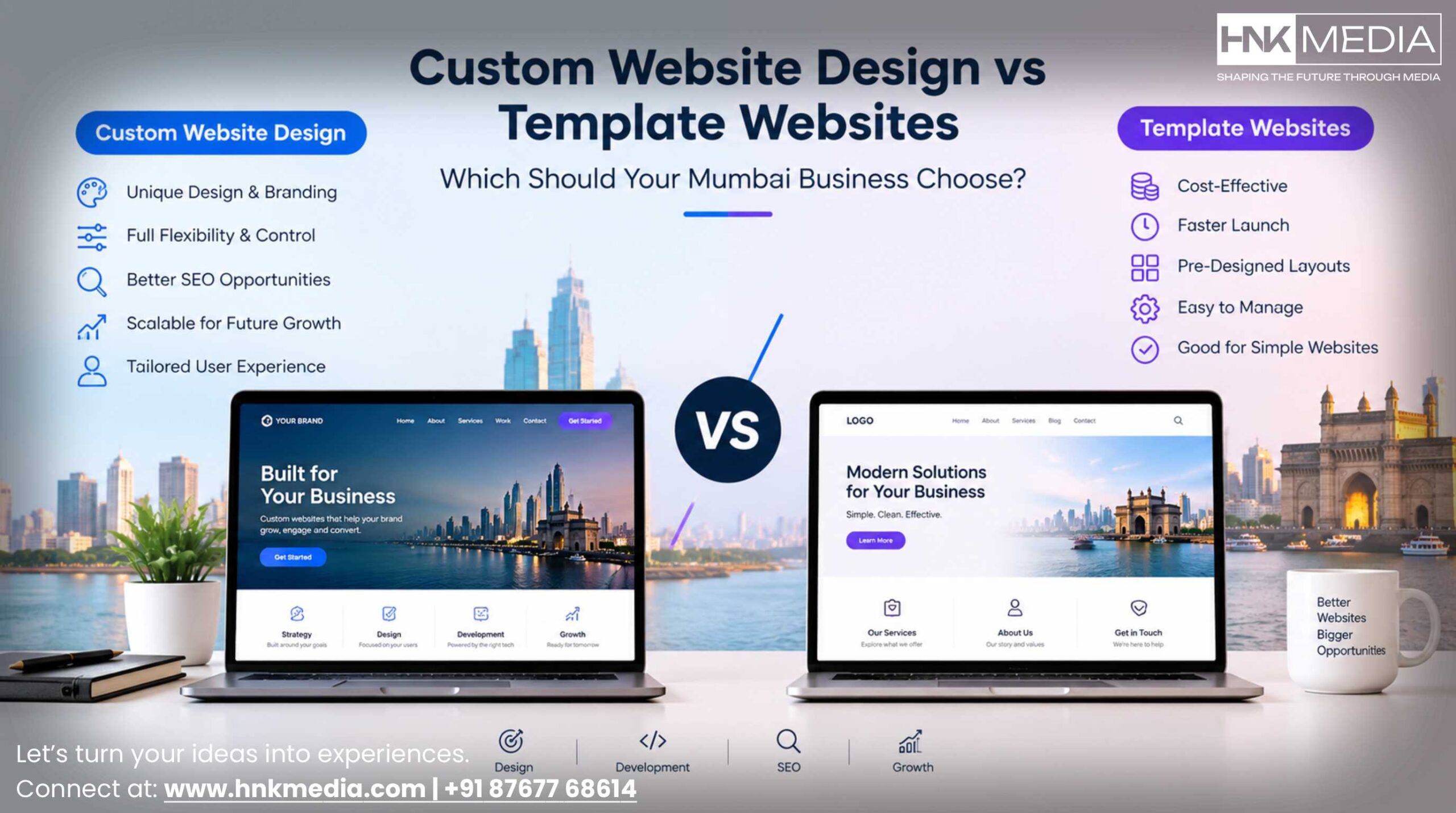
Custom Website vs Template: Which Is Better for Mumbai Businesses?
Published on September 28, 2026 by Sanaullah Khan
If you are planning a new website for your business, one question usually comes up early:
Should you choose a custom website design or use a ready-made template?
At first, a template website may seem like the easier option. It can be faster to launch, and the initial cost is often lower. You can select a design, add your logo, change the colours, upload images and publish the website.
However, your website is more than an online brochure.
For many businesses, the website is the first place where potential customers learn about the company. It can influence trust, enquiries, sales, brand perception and even how easily people find your business through Google.
That makes the custom website design vs template website decision more important than it may appear.
A custom website is not automatically the right choice for every business. At the same time, a template website is not automatically a poor choice.
The better question is:
What does your website need to achieve for your business?
In this guide, we will compare custom websites and template websites based on design, cost, SEO, speed, user experience, scalability, branding and long-term value.
We will also explain when a Mumbai business should consider a template, a custom website or a semi-custom approach.
Quick Answer: Custom Website or Template Website?
A template website can be a practical choice if you need a simple online presence, have a limited budget or want to launch quickly.
On the other hand, custom website design can make more sense when your website needs to generate leads, support SEO, represent a premium brand, sell products or provide specific features.
The right option depends on your:
Business goals
Budget
Target audience
Website requirements
SEO strategy
Brand positioning
Growth plans
Required integrations
Customer journey
For example, a small local business that needs five basic pages may not need a completely custom website.
However, a growing Mumbai business competing for valuable search terms may need more control over its website structure, content, UX and conversion journey.
So, instead of asking which option is universally better, start by asking what your business actually needs.
What Is a Template Website?
A template website uses a pre-designed website layout created by a theme developer, website builder or e-commerce platform.
The basic structure already exists. You then customise elements such as:
Logo
Colours
Fonts
Images
Text
Menus
Pages
Buttons
Contact information
WordPress, Shopify and other website platforms offer thousands of themes and templates.
This approach can save time because the basic design and structure are already available.
For a small business, that can be useful.
However, a template is designed to work for a broad range of businesses. It may not have been created around your specific customers, sales process or conversion goals.
That difference becomes more noticeable as your business grows.
Advantages of a Template Website
A template website can offer several benefits:
Lower initial development cost
Faster launch
Ready-made design structure
Easier setup
Large selection of layouts
Useful for simple websites
Suitable for businesses with limited requirements
For example, a local consultant may only need a homepage, about page, service page, testimonials and contact page.
In that situation, a well-designed template can be enough.
Limitations of a Template Website
Templates also have limitations.
The design may look similar to other websites using the same theme. Some themes include features that your business may never use. Others may rely heavily on plugins or custom settings.
As a result, you may eventually face problems with:
Design flexibility
Website speed
Plugin dependency
Custom functionality
UX control
Website scalability
Technical SEO
A good template can still work very well. The important point is to understand its limitations before choosing it.
What Is a Custom Website?
A custom website is designed and developed around the specific requirements of a business.
Instead of starting with a fixed layout, the project starts with questions such as:
Who are your customers?
Who are your customers?
What do they need to know before contacting you?
Which services or products should receive the most attention?
What action should visitors take?
How will people find the website through Google?
What should the website be able to do in the future?
The answers influence the sitemap, content structure, navigation, UI/UX, page layouts and conversion journey.
That means the website is built around the business instead of forcing the business into a pre-existing layout.
Advantages of Custom Website Design
A custom website can provide greater control over:
Brand identity
User experience
Website architecture
Page layouts
Conversion paths
SEO structure
Custom functionality
Integrations
Future scalability
For businesses where the website is an important sales or marketing channel, this additional control can be valuable.
Is Custom Always Better?
No.
This is an important point.
A poorly planned custom website can perform worse than a well-built template website.
A custom design does not automatically mean better SEO, faster loading or more conversions.
The result depends on the quality of strategy, design, development, content and optimisation.
Therefore, the goal should not be to choose the most expensive option.
Instead, choose the approach that fits the business.
Custom Website Design vs Template Website: Key Differences
The following comparison can help you understand the difference.
Factor
Template Website
Custom Website
Initial cost
Usually lower
Usually higher
Development time
Faster
Usually longer
Design flexibility
Limited by theme
High
Brand uniqueness
Moderate
High
UX control
Limited
Extensive
Custom features
Often plugin-based
Built around requirements
SEO control
Depends on theme and setup
Greater control
Scalability
Can become restrictive
Easier to plan for growth
Maintenance
Theme/plugin dependent
Depends on development approach
Best suited for
Simple websites
Growing or complex businesses
The comparison shows why there is no single answer for every business.
A startup website, local service website and large e-commerce website can have completely different requirements.
Custom Website vs Template: Which Is Better for SEO?
This is one of the most common questions.
The simple answer is:
Neither option automatically ranks higher on Google.
Google does not give a website a ranking advantage simply because it was custom designed.
Instead, search visibility depends on many factors, including content quality, relevance, technical accessibility, site structure, user experience and other signals.
Google’s current Search documentation explains that its systems look at overall page experience. Core Web Vitals are part of the ranking systems, but good scores alone do not guarantee top rankings.
A custom website can give you more control over areas such as:
URL structure
Website architecture
Heading hierarchy
Internal linking
Schema markup
Page templates
Image optimisation
Mobile experience
Technical SEO
Conversion paths
However, a good template can also support many of these requirements.
The problem starts when a theme becomes difficult to customise or includes unnecessary code, plugins or features.
Therefore, instead of asking:
“Is custom website design better for SEO?”
Ask:
“Which approach gives my business enough SEO control for its goals?”
That is a much more useful question.
Website Speed and Core Web Vitals
Website speed matters for both users and businesses.
People are less likely to wait for a page that takes too long to load. A slow website can also create a poor mobile experience.
Google recommends paying attention to Core Web Vitals, which measure areas such as loading performance, responsiveness and visual stability. However, Google also makes it clear that achieving good Core Web Vitals does not guarantee higher search rankings.
A template website can be fast.
A custom website can also be fast.
The development method alone does not determine performance.
Instead, speed depends on factors such as:
Hosting
Image size
JavaScript
CSS
Plugins
Fonts
Third-party scripts
Caching
Database performance
Code quality
For example, some large themes include many design features that a business may never use.
If those features add unnecessary page weight, performance can suffer.
A carefully planned custom website can avoid unnecessary elements. At the same time, a well-optimised template can also perform very well.
Therefore, performance should be considered during development rather than treated as an afterthought.
Custom Website Design Gives You More Branding Control
Your website should feel like an extension of your brand.
That becomes especially important in competitive markets such as Mumbai.
A customer comparing different companies may notice:
Logo usage
Typography
Colours
Photography
Layout
Messaging
Visual hierarchy
Tone of voice
User experience
A template can certainly be customised.
However, its underlying structure still comes from someone else’s design system.
Custom website design gives you more freedom to create a digital experience around your own positioning.
For example, a luxury jewellery brand may need a different website experience from an industrial B2B company.
A real estate company may need a different structure from a restaurant.
A SaaS company may need a different customer journey from a local service provider.
The website should reflect those differences.
This is where UI/UX design and branding become important.
HNK Media’s current services include UI/UX and Experience Design, including UX strategy, wireframing, prototyping and usability testing.
Custom Website vs Template: Which Is More Scalable?
A website that works today may not work as well when the business grows.
Over time, you may add:
New services
New locations
More products
New landing pages
Online payments
Customer accounts
Booking systems
CRM integrations
Marketing automation
Advanced forms
Product filters
New content categories
A template can support some of these requirements.
However, problems can appear when a business keeps adding plugins, workarounds and custom modifications to a theme that was never designed for those requirements.
A custom website can be planned with future needs in mind.
That does not mean you should build every possible feature from day one.
Instead, the website architecture can leave room for future development.
This approach can reduce the need for major structural changes later.
When Should a Mumbai Business Choose a Template Website?
A template website can be a sensible choice in several situations.
You Need a Website Quickly
If you need an online presence within a short timeframe, a good template can reduce development time.
You Have a Limited Budget
New businesses often need to divide their budget between website development, marketing, operations and product development.
A template can keep the initial website investment lower.
You Need a Simple Website
A basic five-page website may not require complex custom development.
For example:
Home
About
Services
Gallery
Contact
A well-designed template can handle this type of project.
You Are Testing a New Business Idea
If you are still validating your business model, a simple website may be enough to start.
Launch the business.
Learn from customers.
Then invest further once the requirements become clearer.
Your Website Is Mainly Informational
Some businesses mainly receive customers through referrals, marketplaces, social media or offline channels.
In that situation, the website may mainly provide credibility and basic information.
A template can be suitable.
When Should a Mumbai Business Choose Custom Website Design?
Custom development becomes more useful when the website has an important role in business growth.
Your Website Generates Leads
If your website is responsible for enquiries, consultations or sales, the customer journey deserves careful planning.
Every step matters.
The visitor should understand your offer quickly and know what to do next.
You Are Competing for Organic Search Traffic
Competitive SEO requires more than attractive visuals.
You may need:
Service pages
Location pages
Topic clusters
Internal links
Technical SEO
Structured data
Content hubs
Landing pages
Strong information architecture
A custom approach can give you more control over these elements.
Your Brand Needs a Unique Digital Identity
If your brand needs to stand apart from competitors, a generic template may not communicate the positioning you want.
Custom UI/UX gives you more freedom.
You Need Special Features
Custom development can be useful for requirements such as:
Product configurators
Custom calculators
Booking systems
Customer dashboards
CRM integrations
API connections
Membership systems
Advanced search
Custom e-commerce features
A template and plugins may handle some of these requirements.
However, more complex projects may require a more controlled development approach.
You Plan to Scale
If the website will become a major business channel, consider future requirements before choosing the cheapest initial solution.
A website should support growth rather than create unnecessary limitations.
What About a Semi-Custom Website?
There is another option that many businesses overlook.
You do not always have to choose between:
100% template
and
100% custom development.
A semi-custom website can provide a middle ground.
For example, a business can use WordPress as its CMS while creating a customised UI/UX system around the brand and customer journey.
This approach can provide:
Faster development
Easier content management
Better brand control
Custom page layouts
SEO flexibility
More control than a standard theme
Lower development complexity than some fully custom platforms
For many small and medium-sized businesses, this can be a practical solution.
The important point is to choose the technology based on your requirements rather than choosing a template only because it appears cheaper.
How Much Does a Custom Website Cost in Mumbai?
There is no single price for custom website development.
The total cost can depend on:
Number of pages
UI/UX complexity
CMS
Development technology
E-commerce requirements
Integrations
Custom functionality
Content requirements
SEO requirements
Testing
Maintenance
A template website generally requires less design and development work.
Custom website design usually requires more strategy, design and development time.
However, the cheapest website is not always the cheapest business decision.
Suppose a website costs less but produces very few enquiries.
You may later spend more on redesigning it, fixing technical problems or rebuilding the website.
Therefore, it is better to compare business value rather than only initial development cost.
Template Website vs Custom Website: Cost vs Value
Think about your website as a business asset.
A template may provide good value when your requirements are simple.
Custom website development may provide more value when the website directly supports revenue.
For example, a Mumbai restaurant that mainly needs its menu, location and contact information may not need extensive custom development.
On the other hand, a real estate company with multiple projects, location pages, lead forms and advertising landing pages may need much more control.
An e-commerce business may have even more requirements, including:
Product discovery
Filters
Product comparison
Payments
Cart management
Customer accounts
SEO
Promotions
Analytics
Marketing integrations
In those situations, website architecture becomes a business decision.
Does a Custom Website Rank Higher on Google?
No. Not automatically.
Google does not rank a website higher simply because it uses a custom design.
A well-optimised template website can outrank a poorly developed custom website.
However, custom development can give you greater control over technical SEO, website architecture, content structure, performance and user experience.
Google’s documentation recommends focusing on helpful content and overall page experience rather than trying to optimise for one isolated ranking factor.
For structured data, Google explains that markup can help it understand the content on a page and may make pages eligible for certain search features.
Therefore, the better goal is to build a website that is:
Useful
Relevant
Fast
Mobile-friendly
Easy to navigate
Technically accessible
Well structured
Search-friendly
Why Internal Linking Matters for Your Website
Internal links connect related pages on your own website.
For example, this article discusses website design, UX and SEO. It can naturally link to related HNK Media content about website leads, agency selection and digital strategy.
That helps readers discover relevant information.
It also creates a clearer website structure.
Google’s documentation recommends making links crawlable and using descriptive anchor text so that users and search engines can better understand the destination page.
For this article, useful HNK internal links include:
Why Your Website Is Not Getting Leads — useful after discussing UX and conversion.
Build a website around the business, not the other way around.
Custom Website Design for Mumbai Businesses
Mumbai is a competitive market.
Businesses in Andheri, Bandra, BKC, Lower Parel, Dadar, Thane and Navi Mumbai compete for attention both offline and online.
Because of that, your website needs to communicate your value quickly.
A strong website should answer five basic questions:
Who are you?
What do you offer?
Who do you serve?
Why should customers trust you?
What should they do next?
These questions apply whether you use a template or custom development.
The difference is how much control you have over the experience.
A template gives you a starting structure.
Custom website design gives you the opportunity to build the structure around your brand, audience and business goals.
How Website Design and SEO Work Together
Design and SEO should not work as completely separate activities.
A beautiful website that receives no relevant traffic has a problem.
A website that receives traffic but confuses visitors has another problem.
The strongest approach connects both sides.
Think about it this way:
SEO helps people discover the website.
Content helps them understand the offer.
UX helps them move through the website.
Design creates clarity and trust.
A strong call to action encourages the next step.
That is why HNK Media combines website design, UI/UX and SEO as part of a broader digital experience approach.
Google’s guidance also encourages site owners to focus on the overall quality of the page experience, including mobile usability, security, Core Web Vitals and clear presentation of the main content.
Custom Website vs Template: Which One Should You Choose?
Use this simple guide before making your decision.
A Template Website May Be Right If:
You need a simple online presence.
Your budget is limited.
You need to launch quickly.
Your website has straightforward requirements.
You are testing a new business idea.
Your website is mainly informational.
You do not need complex integrations.
Custom Website Design Makes Sense If:
Your website is a major source of leads or sales.
You need a unique brand experience.
You compete for valuable Google searches.
You need custom functionality.
You have complex customer journeys.
You need advanced integrations.
You plan to scale the website.
Your website is a major part of your marketing strategy.
A Semi-Custom Website Could Work If:
You want better design control without building everything from scratch.
You want to use WordPress or another CMS.
You need a balance between cost and flexibility.
Your requirements are more advanced than a basic template.
You want a website that can evolve as your business grows.
Final Thoughts: Choose the Website That Fits Your Business
There is no universal answer to the custom website design vs template website question.
A template website can be a sensible choice for a small business with simple requirements.
It can help you launch quickly while keeping the initial investment under control.
However, growing businesses may need more flexibility.
If your website needs to generate leads, support SEO, represent a premium brand, sell products or connect with other business systems, a custom or semi-custom website may provide more control.
The most important point is this:
Do not choose a website only because it is cheap.
Also, do not choose custom development simply because it sounds more premium.
Start with your business goals.
Then choose the technology, design approach and development process that supports those goals.
At HNK Media, we believe a website should do more than look good.
It should help your business communicate, build trust and grow.
Our approach combines strategy, UI/UX, website development, SEO, branding and digital marketing to create digital experiences around real business requirements.
Is a custom website better than a template website?
Not always. A template can be suitable for a simple website with a limited budget and short timeline. Custom website design becomes more useful when you need unique branding, advanced functionality, stronger UX control or a website built around long-term business goals.
Is custom website design worth the cost?
It can be valuable when your website directly supports leads, sales or brand growth. However, businesses with simple requirements may not need a fully custom website. The right decision depends on your goals, budget, audience and website requirements.
Is a template website good for SEO?
Yes. A properly built and optimised template website can perform well in Google Search. However, some themes may create limitations around technical SEO, performance or website structure. SEO depends on the overall quality of the website, not simply whether it uses a template.
Does a custom website rank higher on Google?
No. Google does not automatically rank custom websites higher. A well-optimised template website can outrank a poorly developed custom website. Custom development can, however, provide greater control over website architecture, technical SEO, performance and user experience.
Which website is faster: custom or template?
Either option can be fast.
A custom website can be developed with only the features a business needs. However, a well-optimised template can also perform strongly. Hosting, images, scripts, plugins, code and caching all affect website speed.
How much does a custom website cost in Mumbai?
There is no fixed price. The cost depends on factors such as the number of pages, UI/UX requirements, technology, e-commerce features, integrations, custom functionality, content and SEO requirements.
How long does it take to build a custom website?
The timeline depends on the project scope. A simple custom website can be completed faster than a complex e-commerce platform or web application. Content availability, design approvals, development, testing and revisions can also affect the timeline.
Can a WordPress website be custom designed?
Yes. WordPress can be used with custom UI/UX and custom development. You do not have to use the default appearance of a WordPress theme. WordPress can provide the content management system while the design and user experience are customised for the business.
Is WordPress a template website?
Not necessarily.
WordPress is a content management system. You can use a ready-made theme, customise an existing theme or build a highly customised WordPress website.
Therefore, WordPress itself should not automatically be considered a template website.
Can I redesign my existing template website?
Yes. Depending on the existing technology and code quality, you may be able to improve the UI/UX, content structure, performance and SEO without rebuilding everything.
In some cases, however, rebuilding the website may be more practical.
Should a small business choose a custom website?
It depends on the business.
A small business with simple requirements may be perfectly fine with a good template. However, if the website needs to generate leads, compete in local SEO or support a premium brand, custom design can provide more flexibility.
Which is better for an e-commerce business: custom or template?
Both can work.
A small e-commerce business with standard requirements can start with a well-configured platform and theme. A growing e-commerce brand may eventually need custom UX, advanced filters, integrations, personalised shopping experiences or other features.
The right choice depends on the store’s size, products, customers and growth plans.
Should I choose a cheap website now and redesign it later?
Sometimes that approach makes sense.
A new business may use a simple website while validating its business model. However, if the website will immediately become a major source of leads or sales, building the right foundation from the beginning may reduce future redesign and development costs.
What should I ask a website design company in Mumbai?
Ask about the agency’s design process, development technology, SEO approach, timeline, maintenance, ownership, revisions and post-launch support.
You should also ask to see relevant projects.
Most importantly, ask why the proposed website structure is suitable for your business instead of simply choosing a design because it looks attractive.
Build a Website Around Your Business, Not the Other Way Around
The custom website design vs template website decision should always start with your business goals.
If you only need a basic online presence, a template can be a practical choice.
If your website is expected to support SEO, generate leads, sell products and represent your brand, you may need a more customised approach.
There is also a middle path.
A well-planned semi-custom website can provide a useful balance between cost, speed and flexibility.
At HNK Media, we help businesses understand these choices and select an approach based on their actual requirements.
Our work combines website development, UI/UX, SEO, branding and digital marketing so that your website supports the larger business strategy.
Your website should not simply exist online.
It should have a job to do.
If you are ready to build or redesign your website, explore HNK Media and see how we can help create a digital experience designed around your business.
4.9(13)· Top rated
HNK Media Mumbai helped improve the UI/UX design of my platform…faizan

 Call 24/7 Hours +91 87677 68614
 Send Us Mail info@hnkmedia.com