AI Agents vs Chatbots: What’s the Difference for Businesses?
Published on November 24, 2026 by sanaullah7867@gmail.com
Artificial Intelligence is changing how businesses communicate with customers, manage operations, and deliver services. From answering customer questions to automating complex business processes, AI-powered technologies are helping organisations work more efficiently.
Two technologies gaining significant attention are AI agents and AI chatbots.
Although these terms are sometimes used interchangeably, they are not the same. Both can interact with users through natural language, but their capabilities, responsibilities, and levels of autonomy can be very different.
A traditional chatbot primarily responds to user questions and follows predefined conversation flows. An AI agent can go further by understanding objectives, making decisions within defined boundaries, using connected tools, and executing multiple steps to complete a task.
So, which technology should your business choose?
In this guide, we will explain the difference between AI agents and chatbots, how they work, their business applications, advantages, limitations, and how to choose the right solution for your organisation.
What Is an AI Chatbot?
An AI chatbot is a software application designed to communicate with users through text or voice. It uses artificial intelligence and natural language processing to understand questions and generate relevant responses.
Modern AI chatbots can understand conversational language, maintain context, answer frequently asked questions, and assist users with different tasks.
Unlike older rule-based chatbots, which rely on fixed scripts and predefined options, AI-powered chatbots can generate more flexible responses using large language models.
How Do AI Chatbots Work?
An AI chatbot generally follows this process:
A user sends a question or message.
The chatbot analyses the message.
Its AI model interprets the user’s intent.
It generates an appropriate response using available information.
The conversation continues based on the user’s next message.
Depending on its integrations, a chatbot may also retrieve information from a knowledge base, collect customer details, create support tickets, or connect users with human representatives.
Business Applications of AI Chatbots
Businesses commonly use AI chatbots for:
Answering frequently asked questions.
Website visitor engagement.
Customer support.
Product and service information.
Appointment enquiries.
Basic lead collection.
Order status updates.
Customer onboarding.
Example: A customer visits a digital agency’s website and asks, “How much does a business website cost?”
The chatbot can explain the available website development services, ask about the customer’s requirements, and collect contact details for a consultation.
The primary purpose is to make customer communication faster and more accessible.
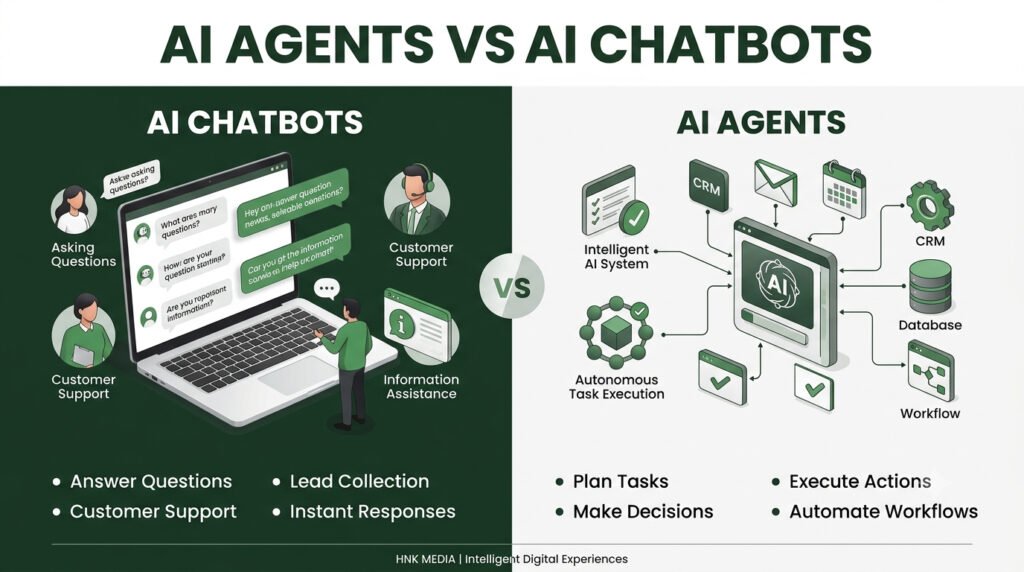
Understand how AI agents and chatbots differ in functionality, communication, and business automation.
What Is an AI Agent?
An AI agent is an intelligent software system designed to understand a goal, determine the steps needed to achieve it, and perform actions using available tools and integrations.
Unlike a chatbot that primarily focuses on responding to conversations, an AI agent can be designed to execute tasks and manage workflows.
Depending on its permissions and configuration, an AI agent can:
Research potential business customers.
Analyse and qualify incoming leads.
Update CRM records.
Draft personalised emails.
Schedule appointments.
Retrieve information from connected systems.
Generate reports.
Trigger business automation workflows.
AI agents can use language models, business rules, external tools, databases, APIs, and memory mechanisms to complete tasks.
However, their autonomy is not unlimited. Their capabilities depend on the tools they can access, the permissions they receive, and the safeguards implemented by the business.
How Do AI Agents Work?
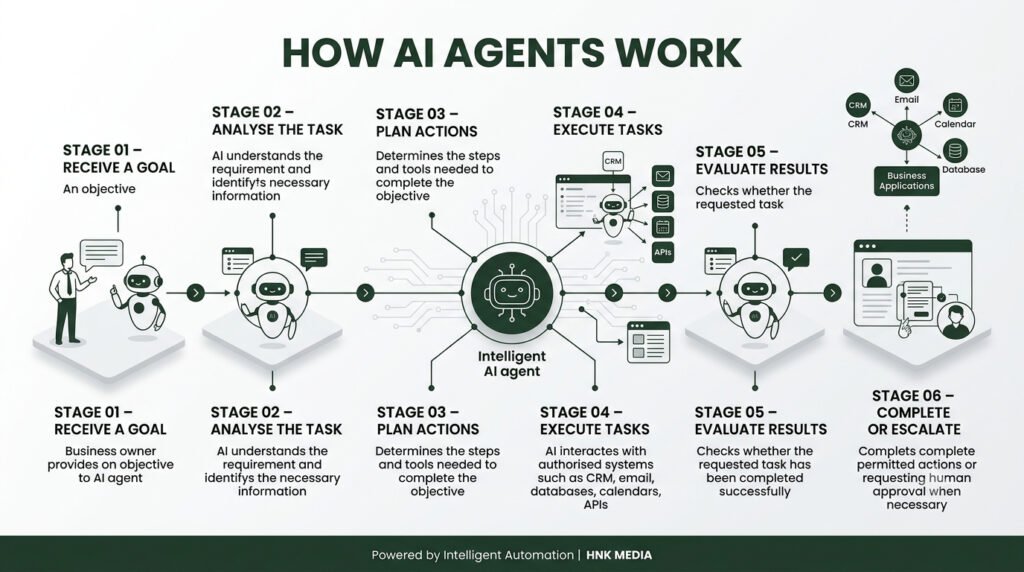
An AI agent generally follows a goal-oriented process:
Receive a goal: Understand what the user or business wants to accomplish.
Analyse the task: Break the objective into smaller steps.
Plan actions: Determine which tools and information are required.
Execute tasks: Interact with connected applications and systems.
Evaluate results: Check whether the actions achieved the intended outcome.
Continue or escalate: Perform additional permitted actions or request human assistance.
This ability to coordinate multiple actions makes AI agents useful for more complex business workflows.
Explore how AI agents understand goals, plan actions, execute tasks, and automate business workflows.
Business Applications of AI Agents
AI agents can support several business operations:
Automated lead research and qualification.
AI-powered sales workflows.
CRM management.
Customer onboarding.
Appointment scheduling.
Internal business process automation.
Document processing.
Customer support escalation.
Data analysis and reporting.
Example: A business receives a website enquiry from a potential customer interested in website development.
An AI sales agent can analyse the enquiry, identify the requested service, check the customer’s requirements, create a CRM record, assign a lead category, prepare a personalised follow-up email, and notify the sales team.
Instead of simply answering a question, the agent helps move the sales process forward.
AI Agents vs Chatbots: Key Differences
The biggest difference between AI agents and chatbots is their primary purpose.
Chatbots are generally designed for conversational interaction, while AI agents are designed to achieve objectives through actions and decision-making within defined boundaries.
Comparison
AI Chatbots
AI Agents
Primary purpose
Answer questions and communicate
Complete tasks and achieve goals
Functionality
Conversational assistance
Goal-oriented execution
Decision-making
Usually limited to conversation and configured logic
Can plan and select actions within permissions
Task execution
Basic or integration-dependent
Can execute multi-step workflows
Integrations
FAQs, CRM, knowledge bases
CRM, APIs, databases, business applications
Automation
Mostly conversational workflows
Complex business process automation
Human involvement
Often needed for complex requests
Can handle permitted tasks independently
Complexity
Generally simpler to implement
Usually requires more planning and controls
Business use
Customer engagement and support
Sales, operations, research, and workflow automation
Important: These categories can overlap. An advanced chatbot may use tools and perform actions, while an AI agent may communicate through a chatbot interface. The distinction is primarily about the system’s capabilities and responsibilities, not how the user interacts with it.
Real-World Business Examples: AI Agents vs Chatbots
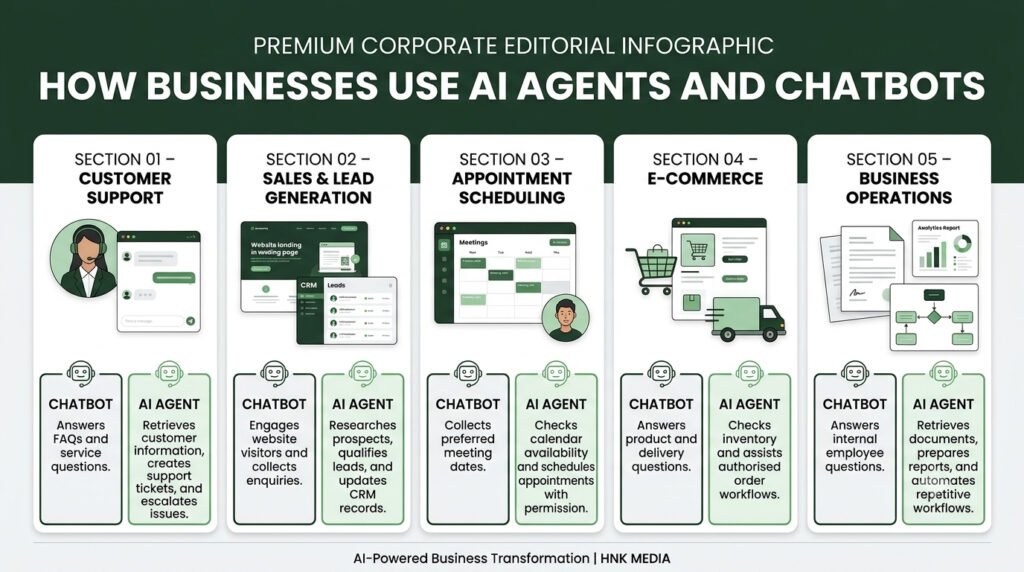
Understanding the difference becomes easier when we compare how both technologies handle the same business situations.
1. Customer Support
AI Chatbot: Answers common questions about services, pricing, working hours, and policies.
AI Agent: Can retrieve order information, check an authorised system, create support tickets, initiate permitted workflows, and escalate unresolved issues.
2. Sales and Lead Generation
AI Chatbot: Engages website visitors, collects contact information, and answers questions about products or services.
AI Agent: Can research prospects, qualify leads, update CRM records, prepare follow-ups, and coordinate sales activities.
3. Appointment Scheduling
AI Chatbot: Asks customers about their preferred meeting date and time.
AI Agent: Can check calendar availability, identify suitable time slots, create appointments, and send confirmations when authorised.
4. E-Commerce
AI Chatbot: Helps customers find products and answers questions about delivery and returns.
AI Agent: Can retrieve product information, check inventory through connected systems, assist with order-related workflows, and initiate permitted actions.
5. Internal Business Operations
AI Chatbot: Answers employees’ questions about company policies and internal documentation.
AI Agent: Can retrieve documents, prepare reports, update approved records, and coordinate repetitive operational tasks.
Benefits of AI Chatbots for Businesses
AI chatbots are particularly useful for businesses that want to improve communication and customer engagement.
Key benefits include:
1. Faster customer responses: Chatbots can respond to common enquiries without requiring a human representative for every interaction.
2. 24/7 availability: Website visitors can receive assistance outside normal business hours.
3. Reduced repetitive work: Customer support teams can spend less time answering the same questions.
4. Better enquiry collection: Chatbots can collect customer requirements and contact information.
5. Improved customer experience: Customers can quickly find relevant information through conversational interactions.
Discover how businesses use AI agents and chatbots to improve customer support, sales, and daily operations.
Benefits of AI Agents for Businesses
AI agents offer additional opportunities for businesses that want to automate processes beyond basic conversations.
1. End-to-end workflow automation: Agents can coordinate multiple steps across connected business applications.
2. Improved sales operations: AI agents can support prospect research, lead qualification, and follow-up management.
3. Reduced manual administration: Repetitive activities such as data entry, information retrieval, and reporting can be automated.
4. Better operational coordination: Different tools and systems can work together through connected agent workflows.
5. Scalable business processes: Businesses can handle growing operational workloads without increasing every manual activity proportionally.
These benefits depend on the quality of integrations, data, workflow design, and human oversight.
Which Is Better for Your Business: AI Agents or Chatbots?
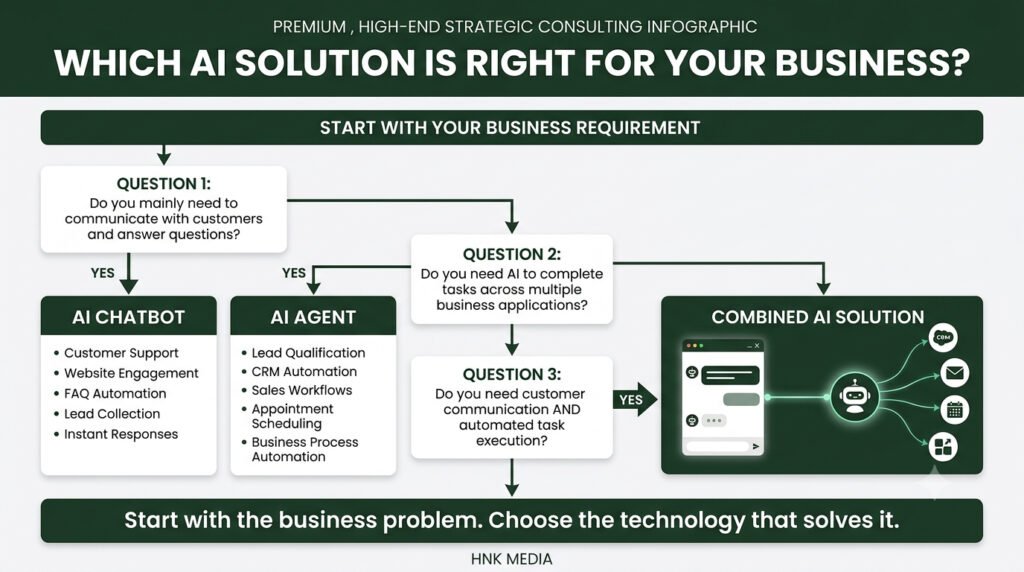
There is no universal answer. The right choice depends on the business problem you want to solve.
Choose an AI chatbot if your primary requirements include:
Answering customer questions.
Engaging website visitors.
Collecting enquiries.
Providing basic customer support.
Sharing product and service information.
Improving website communication.
Choose an AI agent if your business needs:
Automated lead research.
Multi-step sales workflows.
CRM updates and coordination.
Automated appointment management.
Data processing and reporting.
Connected business process automation.
Can Businesses Use AI Agents and Chatbots Together?
Absolutely. In many cases, combining both technologies creates a more effective solution.
An AI chatbot can act as the communication interface, while an AI agent handles the tasks required behind the scenes.
For example, consider a business website with an intelligent customer assistant.
A visitor starts a conversation with the chatbot.
The chatbot understands the customer’s requirements.
It collects relevant information.
An AI agent evaluates and qualifies the enquiry.
The agent creates or updates the CRM record.
It prepares the next action for the sales team.
The chatbot communicates the next steps to the visitor.
This creates a connected customer experience supported by automated business processes.
How to Implement AI Agents and Chatbots in Your Business
Implementing AI technology successfully requires more than selecting a software platform. Businesses should first identify the processes they want to improve.
Step 1: Identify Your Business Requirements
List the activities that consume the most time or create operational challenges.
Examples include repetitive customer enquiries, missed leads, manual CRM updates, delayed follow-ups, and appointment management.
Step 2: Choose the Right Technology
Determine whether your requirement needs a conversational chatbot, an AI agent, or a combination of both.
Avoid implementing complex agent systems when a simple chatbot can solve the problem.
Step 3: Connect Your Business Systems
Integrate the solution with relevant platforms such as your website, CRM, email system, calendar, database, and approved communication channels.
Step 4: Define Permissions and Safeguards
Establish which actions the AI can perform independently and which require human approval.
Sensitive operations, financial transactions, customer data changes, and external communications should have suitable access controls.
Step 5: Test Different Scenarios
Test normal conversations, incorrect information, unexpected requests, integration failures, duplicate records, and situations requiring human intervention.
Step 6: Monitor and Optimise Performance
Measure response quality, task completion rates, lead conversion, customer satisfaction, processing time, and operational costs.
Use these insights to improve the system over time.
Common Mistakes Businesses Should Avoid
While AI agents and chatbots can improve business operations, poor implementation can create unnecessary complexity.
Avoid these mistakes:
Choosing technology without defining a business objective.
Expecting chatbots to perform complex tasks without suitable integrations.
Giving AI agents excessive permissions.
Connecting unreliable or outdated data sources.
Ignoring privacy and security requirements.
Automating important decisions without human oversight.
Failing to test workflows before deployment.
Measuring activity instead of actual business outcomes.
The most effective AI solutions are designed around specific business needs, with clear responsibilities and appropriate safeguards.
The Future of AI Agents and Chatbots in Business
The development of AI is moving beyond simple question-and-answer interactions.
Modern AI systems are increasingly capable of understanding context, using external tools, coordinating workflows, and assisting with complex tasks.
Businesses can expect more connected AI experiences where conversational interfaces, intelligent agents, CRM systems, and business applications work together.
However, successful implementation will depend on more than AI capabilities. Reliable data, strong security, clear workflows, and human supervision will remain essential.
Companies that understand how to combine conversational AI with task-oriented automation can create more efficient customer experiences and business operations.
Compare AI chatbots, AI agents, and combined solutions to choose the right technology for your business.
Frequently Asked Questions About AI Agents and Chatbots
1. What is the main difference between AI agents and chatbots?
The main difference is their functionality. AI chatbots primarily communicate with users and answer questions, while AI agents can understand goals, make decisions within defined boundaries, and execute tasks using connected tools and applications.
2. Are AI agents better than chatbots?
AI agents are not necessarily better than chatbots. Chatbots are suitable for customer communication and basic support, while AI agents are more suitable for complex workflows, sales automation, and multi-step business operations. The right solution depends on your business requirements.
3. Can an AI chatbot become an AI agent?
Yes. A chatbot can be enhanced with tool integrations, business logic, task execution capabilities, and agent-based workflows. However, adding these capabilities requires suitable architecture, permissions, and safeguards.
4. How do AI agents help businesses?
AI agents help businesses automate repetitive tasks, qualify leads, manage CRM records, research prospects, schedule appointments, process information, and coordinate workflows across connected applications.
5. Can AI agents generate leads automatically?
Yes. AI agents can support lead generation by researching prospects, analysing publicly available business information, qualifying potential customers, organising lead records, and preparing personalised outreach. Human review and appropriate consent are important for external communications.
6. Are AI chatbots suitable for small businesses?
Yes. Small businesses can use AI chatbots to answer customer questions, collect enquiries, provide service information, and improve website engagement without requiring a large customer support team.
7. Can AI agents integrate with CRM software?
Yes. AI agents can integrate with compatible CRM platforms through APIs and authorised connectors. They can help create lead records, update customer information, summarise conversations, and coordinate follow-up activities.
8. What is the difference between AI agents and traditional automation?
Traditional automation generally follows predefined rules and workflows. AI agents can interpret context, select suitable actions, and adapt their approach within defined limits. Both technologies can work together to automate business processes.
9. How much does it cost to develop an AI agent or chatbot?
Development costs depend on functionality, AI model selection, integrations, data requirements, security, and workflow complexity. A basic chatbot is generally simpler to implement than a customised AI agent connected to multiple business systems.
10. Should my business use AI agents and chatbots together?
Yes. Combining both technologies can create an effective business automation system. A chatbot can communicate with customers, while an AI agent handles background activities such as lead qualification, CRM updates, appointment scheduling, and workflow management.
Conclusion: Choosing the Right AI Solution for Your Business
AI agents and chatbots both offer valuable opportunities for modern businesses, but they solve different problems.
Chatbots are ideal for customer conversations, website engagement, and answering common questions. AI agents go further by planning and executing tasks, interacting with connected systems, and automating multi-step workflows.
For businesses looking to improve customer communication, an AI chatbot can be a practical starting point. For organisations aiming to automate sales operations, lead generation, and internal processes, AI agents can offer broader capabilities.
In many situations, combining both technologies delivers the strongest results.
At HNK MEDIA, we believe AI should do more than answer questions. It should help businesses solve real problems, improve customer experiences, and simplify everyday operations.
Whether you need an intelligent chatbot, an AI sales agent, or a customised business automation system, the right solution starts with understanding your business goals.
Connect with HNK MEDIA to explore intelligent AI automation solutions built around your business requirements.
4.9(15)Top rated
I’m extremely satisfied with HNK Media’s services…Apoorva
 Call 24/7 Hours +91 87677 68614
 Send Us Mail info@hnkmedia.com