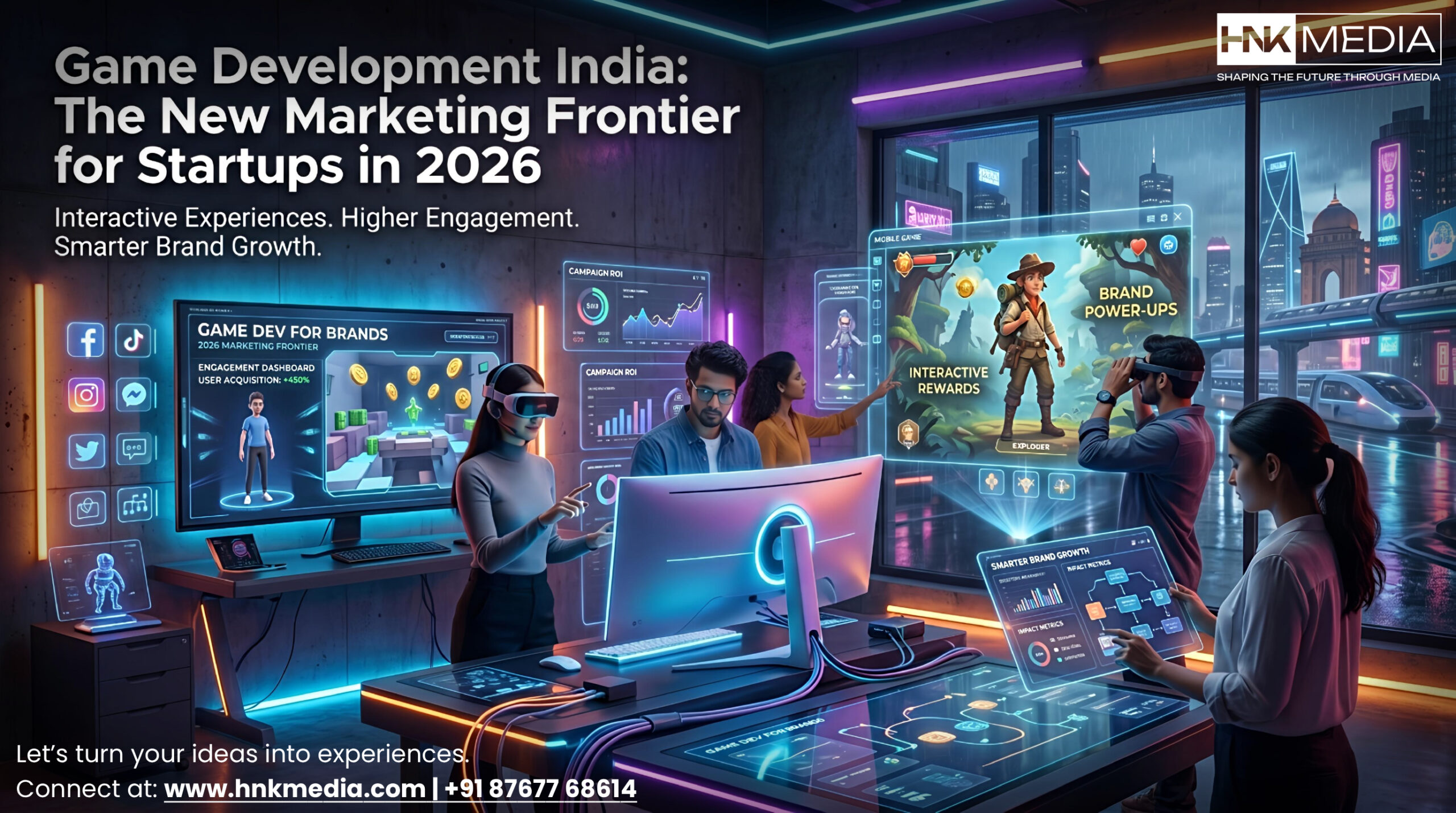
India crossed 500 million active mobile gamers in 2024. It is now the fastest-growing gaming market in the world by total user base. That number is not slowing down. By 2028, projections point to over 700 million Indian gamers — a figure larger than the entire population of Europe.
For Indian startups and brands, game development India is no longer a niche technology investment or an entertainment category to observe from a distance. It is a live, active, and largely underexploited marketing opportunity. The brands that understand this in 2026 and act on it will build customer engagement advantages that competitors will struggle to close for years.
At HNK Media, our game design and development team in Mumbai works at the intersection of brand strategy and interactive experience. This article covers everything a founder or marketing lead needs to understand about game development India — what the market actually looks like, why gamification works differently in India than anywhere else, and how to use game mechanics as a genuine brand marketing advantage.
What Game Development India Actually Looks Like in 2026
The Market Size and Why It Matters for Marketers
Game development India has grown from a supporting role in the global gaming industry to a central one in less than a decade. India’s gaming revenue crossed $3.8 billion in 2024 and is growing at over 20% annually. Mobile accounts for over 85% of all gaming activity. And crucially — India’s gaming growth is coming from a user base that is already enormous and still expanding rapidly into tier-2 and tier-3 cities.
For brands, this is not an abstract statistic. It means that gaming is now one of the primary ways Indian consumers spend discretionary time. Every minute a potential customer spends inside a well-designed game experience is a minute they are not watching an ad, scrolling a feed, or being interrupted by something they did not choose.
Game development India creates the conditions for something rare in modern marketing: voluntary, sustained consumer attention. Attention earned — not interrupted.
The Demographics That Defy Every Assumption
The most important insight about game development India in 2026 is who the Indian gamer actually is. Western assumptions about gaming demographics are almost entirely wrong when applied to India.
The average Indian mobile gamer is not a teenage boy playing first-person shooters in the evening. The average Indian mobile gamer in 2026 is a 24-38-year-old working adult — frequently female — playing casual and mid-core games in 15-30 minute sessions during a commute, a lunch break, or an evening wind-down. She plays Ludo King, Candy Crush, Rummy, Teen Patti, or Dream11. She is a qualified professional, a household decision-maker, and a consumer with real purchasing power.
This demographic profile changes everything about how game development India should be approached from a marketing perspective. You are not designing for teenage escapism. You are designing for habitual, session-based engagement from adults who spend money on the products they encounter in the brands they trust.
Understanding how gaming mechanics work for this audience — what keeps them coming back, what makes them share, what makes them convert — is the foundation of effective game marketing in India. Our UI/UX design work for Indian startups consistently shows that user behaviour patterns in India’s gaming audience differ substantially from global patterns. Designing without understanding this means leaving both engagement and revenue on the table.
Why Game Development India Is a Different Discipline Than Global Game Design
The Genres That Actually Work in India
Game development India requires building for a completely different genre preference than the Western market. First-person shooters, real-time strategy games, and open-world adventures — the categories that dominate Western gaming revenues — are niche in India. The categories that dominate Indian gaming are: casual puzzle games, card games like Rummy and Teen Patti, cricket simulation games, fantasy sports platforms like Dream11 and MPL, and word and trivia games.
These are not lower-quality or less sophisticated categories. They are differently sophisticated categories that reward different kinds of design thinking. Casual games must hook a player within the first 90 seconds or they are gone. Card games require precise rule implementation and fairness mechanics that build trust over time. Fantasy sports demand data integration, real-time updating, and social comparison mechanics that create habit through competitive engagement.
For brands building game development India strategies, this genre landscape is both a constraint and an opportunity. The constraint is that a gaming strategy built on Western genre assumptions will fail in the Indian market. The opportunity is that the genres that work in India — casual, social, competitive, session-based — are precisely the genres that are most amenable to brand integration. A branded puzzle game, a cricket simulation with a sponsor at its core, a loyalty programme designed as a collection game — these fit naturally into how Indian consumers already play.
The WhatsApp Factor in Game Development India
No analysis of game development India in 2026 is complete without addressing WhatsApp. India has over 500 million WhatsApp users and uses the platform for a range of activities — commerce, customer service, appointment booking, entertainment, and increasingly, gaming — that no other major market replicates.
WhatsApp-native game experiences are a category unique to India. Branded mini-games delivered through WhatsApp Business — playable directly within the chat interface without downloading a separate application — have produced engagement results for Indian D2C brands that are structurally impossible to achieve through conventional advertising. Users play them during the same sessions they use to communicate with family and friends. The context is high trust and high attention. The friction to entry is near zero.
This is one of the most underutilised opportunities in game development India today. We cover the broader trend of how D2C brands in India are using design as a competitive advantage in a separate post — and gamification sits at the heart of what the most forward-thinking D2C brands are building into their customer engagement stack.
Gamification as a Brand Marketing Strategy — How It Actually Works
What Gamification Means in Practice
Gamification and game development India are related but distinct concepts. Gamification means applying specific game design mechanics — reward systems, progression tracking, competitive leaderboards, collection mechanics, challenge structures — to non-gaming brand contexts to make engagement with the brand more motivating and habit-forming.
You do not need to build a full game to use gamification. You need to understand which game mechanics produce which psychological effects and apply the right ones to the specific brand engagement problem you are trying to solve.
The six core gamification mechanics and how Indian brands use them:
Variable reward schedules
Not knowing exactly when the next reward will arrive keeps users engaged longer and returning more frequently. This is the core mechanic behind every successful loyalty programme that works like a game rather than a points counter.
Progress visibility
Showing users exactly how close they are to the next level, the next reward, or the next milestone creates powerful completion motivation. A progress bar that is 70% full is more motivating than a counter showing 700 of 1,000 points, even though they represent the same thing.
Social comparison
Leaderboards, friend rankings, and visible badges create competitive engagement that brings users back daily. Fantasy sports in India have built entire industries on this mechanic.
Collection mechanics
Earning, completing, and assembling sets of virtual items, badges, or achievements drives return visits and long-term engagement. The Pokémon Go phenomenon demonstrated this globally. Indian D2C brands apply the same mechanic to loyalty tiers, seasonal campaigns, and product collections.
Challenge structures
Time-limited events, daily challenges, and progressive difficulty create urgency and routine simultaneously. Fitness apps, learning platforms, and retail brands use challenge structures to build habits.
Unlocking
Content, features, or rewards that become available only after achieving something creates aspiration and sustained engagement. Unlocking the next level of a loyalty programme feels fundamentally different to receiving an automatic discount after reaching a spend threshold.
Real Examples From the Indian Market
The Indian brands applying game development India principles most effectively in 2026 are doing so across multiple categories and at multiple budget levels.
A Mumbai-based D2C skincare brand ran a WhatsApp-native “skin quiz game” during their product launch. Users answered progressively more personalised questions about their skin concerns — each answer unlocking a new stage — and received a personalised product recommendation at the end with a limited-time discount. Time spent with the brand experience averaged 4.2 minutes. Conversion from game completion to purchase was 23%. These are metrics no conventional display or social ad campaign produces at comparable cost.
A food delivery platform redesigned its loyalty programme as a collection game — users earned ingredient-themed badges with each order, building towards completing a “dish” that unlocked premium delivery benefits. Daily active users of the loyalty programme increased 3.4x in the first quarter after launch. Average order frequency among loyalty programme participants increased by 28%.
An EdTech startup applied game development India principles to their content completion problem. They redesigned their course modules as progressive levels with XP points, streak bonuses for consecutive days of learning, and a visible class leaderboard. Course completion rates increased from 18% to 61% in the cohort that went through the gamified version.
These results are not exceptional outliers. They are representative of what well-designed gamification consistently produces when applied to the right problem, for the right Indian audience, with genuine design quality behind it.
The Link Between Good Game Design and Good UX
There is no clean boundary between game development India and UI/UX design for Indian products. The best-designed games in the Indian market and the best-designed Indian digital products share the same underlying principles: clear feedback loops, progressive disclosure of complexity, rewards that feel earned rather than automatic, and social mechanics that make the individual experience feel connected to a community.
Our work at the intersection of AI-driven UX design for Indian startups consistently shows that the applications of AI that produce the best engagement results are those that personalise the experience in ways that mirror game design — adapting to user behaviour, surfacing the right challenge at the right moment, and rewarding progress in ways that feel meaningful rather than mechanical.
If you want to understand how the best global games have mastered these principles, our detailed look at how PUBG changed the gaming landscape and what brands can learn breaks down the engagement loop design, community mechanics, and retention strategy that built one of the world’s most engaged gaming audiences — and what Indian brands can directly apply to their own engagement strategies.
The Case for Building Game Development India Capabilities In-House
Why Indian Startups Are Investing in Game Capabilities
An increasing number of Indian startups are building in-house game development India capabilities. Not to become gaming companies. Not to compete with Dream11 or Mobile Premier League. But to use gamification as a sustainable, owned engagement layer that reduces dependence on paid advertising for customer acquisition and retention.
The logic is straightforward. Paid advertising — Meta Ads, Google Ads, performance marketing — produces results only as long as you keep spending. When the budget pauses, the results pause. We cover this in detail in our post on performance marketing for Indian businesses. But owned engagement mechanisms — a gamified loyalty programme, a branded game, a WhatsApp-native interactive experience — produce results that compound over time. The engaged customer who returns because the loyalty game brings them back is a customer you are not paying to acquire again.
For specific categories, the ROI case for game development India investment is particularly strong: education (completion rates and return rates are the primary business metrics, and gamification is the most effective lever on both), fitness (habit formation is the core product promise, and game mechanics are the most proven habit formation tool), personal finance (engagement with financial data and learning is inherently low-motivation, and gamification changes this dramatically), retail loyalty (the difference between a loyalty programme that drives behaviour and one that is claimed but ignored is almost entirely a game design question), and healthcare (patient adherence, appointment completion, and wellness programme participation all improve substantially with well-designed gamification).
The Investment Level Has Dropped Dramatically
One of the most significant changes in game development India over the last three years is the democratisation of the tooling. Unity and Unreal Engine — two of the world’s most powerful game development platforms — both offer free development tiers for projects below specific revenue thresholds. A startup building a branded mini-game for a WhatsApp campaign does not need enterprise software licences to get started.
Indian game development talent is both world-class and more accessible than equivalent talent in North America or Europe. Mumbai, Pune, and Bangalore have growing communities of skilled mobile game developers, 3D artists, and interaction designers who have built games that compete globally. The cost of accessing this talent in India is a fraction of the equivalent cost in Western markets.
The tooling for building simple gamified experiences — loyalty programme mechanics, WhatsApp-native interactive content, branded mini-games — has also matured to the point where much of it is configurable rather than built from scratch. This dramatically reduces both the time and the cost of a first gamification project for an Indian startup.
What HNK Media Does at This Intersection
Our game design and development practice at HNK Media works with Indian brands at multiple levels of game development integration.
At the campaign level: we design and build branded mini-games, AR-based interactive experiences, and WhatsApp-native game mechanics for specific campaign objectives — product launches, seasonal promotions, community building events. These are time-bounded game development India projects with defined objectives and measurable outcomes.
At the product level: we design gamification layers for ongoing loyalty programmes, referral mechanics, and customer engagement systems that operate continuously rather than as individual campaigns. This is where the compounding returns from game development India investment become most significant — a well-designed loyalty gamification system that runs for three years produces customer behaviour data, habit formation, and community dynamics that no single campaign can replicate.
At the strategy level: we work with founders and marketing leads who are evaluating their game development India strategy — which mechanics are appropriate for their specific customer base, which platforms to activate, how to measure success, and how to sequence the investment from simple gamification to full branded game experiences.
Andheri’s creative ecosystem gives HNK Media access to a collaborative network of game designers, Unity and Unreal developers, 3D artists, motion designers, and UX specialists that most Indian brands could not assemble independently. This network capacity means we can execute game development India projects across a wide range of complexity and budget levels.
The Engagement Metrics That Prove Game Development India Works
Why Games Outperform Conventional Digital Advertising
The core metrics comparison between conventional digital advertising and well-designed game development India experiences is striking and consistent.
A standard Meta Ads campaign for an Indian D2C brand produces an average time-with-brand of 3-8 seconds per impression. A well-designed branded game experience in the same category produces average session durations of 2-8 minutes. That is a 40x difference in brand contact time — and the game contact is voluntary, chosen, and associated with positive emotion rather than interruption.
Click-through rates on Indian digital display advertising average 0.1-0.4%. Conversion rates from completed branded game experiences in the Indian market range from 8-25% depending on category and game design quality. Referral rates — users sharing a game experience with a friend — are effectively zero for conventional advertising and typically 15-35% for well-designed social game mechanics.
The reason these numbers differ so dramatically is not magic. It is the fundamental difference between interrupting someone and inviting them. Games earn attention. Advertising interrupts it.
This is why how Call of Duty built a $30 billion franchise is relevant reading for any Indian brand marketer — not because they are building a military shooter, but because the engagement loop design, community mechanics, and seasonal content strategy that built one of the world’s most loyal gaming audiences are directly transferable to brand engagement architecture. The principles are identical. The application is different.
The Retention Advantage of Gamified Brand Experiences
Customer retention is the most valuable outcome of game development India investment for most brands, and it is the area where the return is most clearly measurable.
A loyalty programme designed with genuine game mechanics — visible progress, meaningful milestones, social elements, and variable rewards — produces fundamentally different customer behaviour than a standard points-and-discounts programme. The difference is not marginal. The gamified programme creates habits. The standard programme creates transactions.
Brands using our social media marketing services in combination with gamified loyalty mechanics consistently see higher repeat purchase rates, higher average order values among engaged loyalty programme participants, and lower churn rates than brands using social media and standard loyalty separately. The combination works because the social content builds the brand relationship and the gamification mechanics build the behaviour habit — two different psychological levers working in the same direction.
How to Start Your Game Development India Strategy
The Right Sequence for Indian Startups
The most common mistake Indian startups make with game development India is starting too big. They imagine a full standalone game, scope a large development project, budget significant capital, and then either never launch or launch something that misses the mark because it was not tested progressively.
The right sequence for most Indian startups is much simpler.
Start with gamification of something you already have. If you have a loyalty programme, redesign its mechanics and If you have a referral programme, add visible progress and milestone rewards. If you have an onboarding flow, add completion tracking and a first-milestone celebration. These are game development India applications that require minimal investment and produce measurable results within weeks.
Then build a WhatsApp mini-experience. A branded quiz, a personality test, a product recommendation flow with game-like progression. These typically require 4-8 weeks of design and development and produce campaign-level results that give you both data and internal confidence for the next investment.
Then consider a branded game or AR experience. This is where the game development India investment becomes more substantial — typically ₹5,00,000 to ₹20,00,000 for a well-designed branded game — but by this point you have evidence from your gamification and mini-experience work that your specific audience responds to interactive engagement, and you are building on a foundation of proven insight rather than assumption.
What Good Gamification Looks Like in Indian Context
Our UI/UX design trends for Indian startups in 2026 post covers the broader design principles that apply across all digital products — and several of these are particularly important for game development India specifically.
Low-bandwidth optimisation matters enormously for Indian gaming. A game that requires a strong internet connection to function will fail in tier-2 and tier-3 India, where your most valuable growth audience increasingly lives. Games designed for offline functionality, progressive loading, and graceful degradation on variable 4G perform significantly better across the Indian user base than games optimised for stable broadband.
Vernacular language support is not optional for game development India at scale. The next 300 million Indian gamers are not English-first. Games and gamified experiences that work in Hindi, Tamil, Telugu, Kannada, Bengali, and Marathi reach an audience exponentially larger than English-only experiences. The investment in localisation pays back directly in user acquisition cost reduction.
Cultural reference points within the game design itself matter more in India than most international game designers expect. Cricket metaphors, festival timing, regional food references, local celebrity associations — these are not decorative additions to Indian game experiences. They are the difference between a game that feels built for Indian users and a game that feels imported and adjusted.
The brands and startups referenced in our Bewakoof case study built their market position precisely by understanding the cultural specificity of their Indian audience at every design touchpoint. The same principle applies directly to game development India — the experiences that win in India are those built from inside the culture, not adapted from outside it.
Frequently Asked Questions
What is game development India and why does it matter for brand marketing?
Game development India refers both to the Indian game development industry — now worth over $3.8 billion annually — and to the practice of building games and gamified experiences specifically for Indian consumers and brands. It matters for brand marketing because India has over 500 million active mobile gamers whose primary gaming sessions happen on mobile during daily routines. Brands that embed their marketing within game mechanics reach this audience during moments of voluntary, high-attention engagement rather than through interruptive advertising. HNK Media’s game development services in Mumbai help Indian brands build these experiences specifically.
What is gamification and how is it different from game development India?
Game development India involves building actual games — standalone applications, WhatsApp-native mini-games, AR experiences, or branded interactive content. Gamification applies specific game mechanics — rewards, progress tracking, leaderboards, collection, challenges — to non-game contexts like loyalty programmes, onboarding flows, and customer engagement systems. Both are valuable. Gamification typically requires less investment and produces results faster. Full game development India projects produce deeper engagement and stronger brand associations over time. Most Indian startups benefit from starting with gamification and building toward fuller game experiences as evidence and confidence accumulate.
Which types of Indian startups benefit most from game development India strategies?
The categories with the strongest proven ROI from game development India investment are EdTech (completion rates and learning habit formation), fitness and wellness (habit building and daily return rates), personal finance (engagement with otherwise low-motivation content), retail loyalty (behaviour change from transactional to habitual), and D2C consumer brands (product discovery, launch awareness, and repeat purchase mechanics). That said, any brand whose primary challenge is customer engagement, retention, or habit formation benefits from applying game development India thinking to their marketing strategy.
How much does game development India cost for a startup?
The range is wide depending on what you build. Gamification of an existing loyalty programme or onboarding flow typically costs ₹1,50,000 to ₹5,00,000. A WhatsApp-native branded mini-game or interactive experience typically costs ₹2,00,000 to ₹8,00,000 and takes 4-8 weeks to build. A full branded mobile game designed for the Indian market typically costs ₹8,00,000 to ₹25,00,000 and takes 3-6 months. AR-based brand experiences typically cost ₹3,00,000 to ₹12,00,000 depending on complexity. These ranges assume working with experienced Indian game development talent, which is significantly more accessible and cost-effective than equivalent Western talent while maintaining globally competitive quality.
What game mechanics work best for Indian consumers?
The mechanics that produce the highest engagement for Indian consumers are collection mechanics tied to cultural reference points, competitive leaderboards with social sharing built in, streak-based rewards that align with daily routine, variable reward schedules that create anticipation around each interaction, and community challenges that allow group participation rather than purely individual play. Indian consumers also respond strongly to real-money or real-value rewards — discount unlocking, cashback mechanics, and product gifting tied to game achievements consistently outperform virtual-only reward systems. Fantasy sports platforms like Dream11 have demonstrated the extraordinary scale that real-stakes competitive game mechanics can achieve in India.
How does HNK Media approach game development India projects?
Our approach at HNK Media begins with understanding the specific engagement problem the brand is trying to solve — whether that is acquisition, retention, loyalty, product discovery, or learning. We then identify which game mechanics and which format (gamification, WhatsApp mini-game, AR experience, or full game) best match both the problem and the available budget. We design and develop in-house, drawing on Andheri’s creative ecosystem for specialist game designers, 3D artists, Unity developers, and motion designers as needed. Every game development India project we deliver is tested with real Indian users before launch and measured against specific engagement and conversion KPIs throughout its lifespan. You can explore our work at hnkmedia.com/our-services/game-development-company-in-mumbai or contact us directly to discuss your specific brief.
What is the future of game development India for brands over the next three years?
Three specific directions are emerging clearly. First, AI-personalised game experiences — games that adapt their difficulty, content, and rewards dynamically based on individual player behaviour are becoming buildable at reasonable cost, and they produce engagement results that static games cannot match. Our case study on AI in UX design for Indian startups gives useful context for how AI personalisation is already reshaping engagement design.
Second, regional language game development India will accelerate — the next major growth wave in Indian gaming comes from vernacular-first users in tier-2 and tier-3 cities, and brands that build game experiences in Hindi, Tamil, Telugu, and other regional languages will access audiences that English-only experiences cannot reach. Third, social gaming tied to commerce — the combination of real-time multiplayer mechanics with direct purchase flows embedded inside the game experience is still early in India but growing fast. The brands experimenting with this combination now will have significant first-mover advantages when it matures.
HNK Media is a full-service creative and digital agency based in Andheri, Mumbai. Our game design and development team works with Indian startups and established brands to build gamified customer experiences, branded interactive content, and complete game products designed for the Indian market.
Ready to explore game development India for your brand? Contact HNK Media → https://www.hnkmedia.com/contact-us
Explore all our services → https://www.hnkmedia.com/our-services/
Read more from our blog → https://hnkmedia.com/blogs/

 Call 24/7 Hours +91 87677 68614
 Send Us Mail info@hnkmedia.com