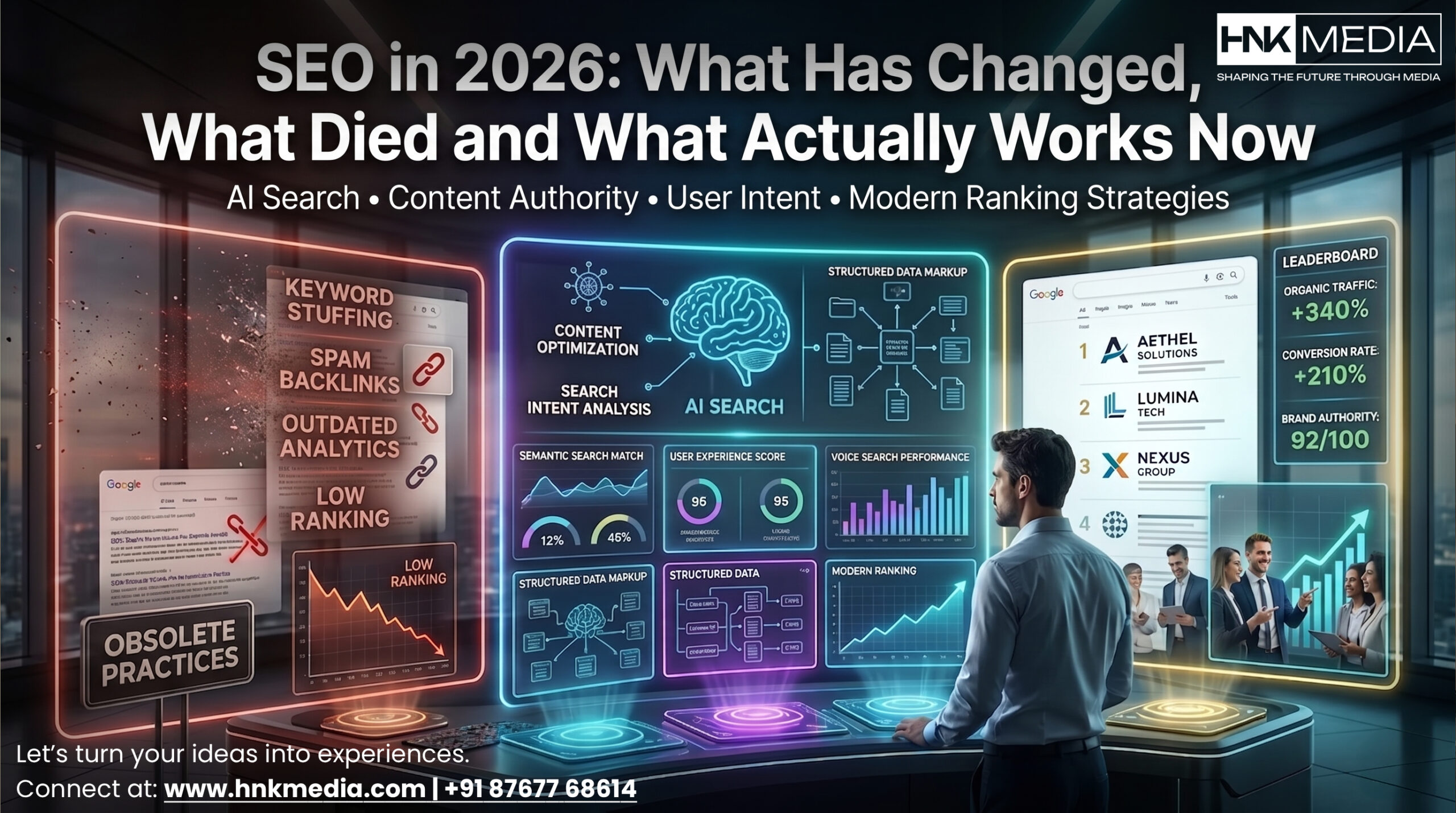
If someone told you in 2018 that stuffing a page with keywords, buying a hundred directory links, and spinning the same article across ten websites would one day get your site penalised rather than ranked — you might not have believed them. But that is exactly where we are.
SEO in 2026 is not an updated version of the SEO that existed five years ago. It is a fundamentally different discipline. The rules have not just changed. The entire game has shifted — the scoring system, the players, the tactics that win, and crucially, the ones that quietly destroy the rankings you spent years building.
At HNK Media, our SEO team in Mumbai works with Indian startups, established businesses, and D2C brands to navigate this new landscape. We see both sides daily — businesses that are growing organic traffic fast because they understand how search has changed, and businesses that are sliding down the rankings because they are still running a 2019 SEO playbook in a 2026 world.
This article is the complete, honest comparison. What SEO looked like then. What it looks like now. and What you need to change immediately. And how to build a strategy that actually compounds in 2026’s search environment.
Why SEO Changed So Dramatically — The Root Cause
Google Grew Up
The simplest way to understand why SEO in 2026 is so different is to understand how Google itself changed. In 2015, Google was a sophisticated keyword-matching machine. It matched search queries to pages that contained those keywords, ranked by the number and quality of links pointing to those pages.
Businesses learned to game this system quickly. Stuff keywords. Build links at scale. Produce large volumes of content regardless of quality. And for years, it worked.
Google spent the following decade teaching itself to understand language, intent, context, and quality — not just keywords and links. With each major algorithm update — Panda, Penguin, Hummingbird, BERT, MUM, and the Helpful Content system — Google got better at answering the question it was actually trying to answer from the beginning: which result will genuinely help this user most?
By 2026, Google has become good enough at this question that most of the old shortcuts not only stop working — they actively harm you.
The Rise of AI Search Changes Everything Again
In 2026, SEO does not happen only on Google’s traditional ten blue links page. It happens on AI-generated answer panels, Google’s SGE (Search Generative Experience), Bing Copilot, ChatGPT search, and Perplexity. These AI search tools pull answers from sources they trust and cite. Ranking in traditional search and appearing as a trusted source in AI answers are now two related but distinct objectives that a modern SEO strategy must address simultaneously.
This is not a distant future development. It is the search environment Indian businesses are operating in right now. Understanding it changes how you approach content, authority, and technical optimisation at every level.
SEO Then vs Now — The Complete Head-to-Head Comparison
Keywords: From Stuffing to Intent
Then: SEO success meant identifying your target keyword — say, “best digital agency Mumbai” — and placing it as many times as possible in your title, headings, URL, image alt text, meta description, and body copy. Ten mentions was good. Twenty was better. The page that mentioned the keyword most often frequently ranked highest, regardless of whether the content was genuinely useful.
Now: Google does not count keyword mentions. It evaluates whether the entire page satisfies the intent behind a search query. If someone searches “best digital agency Mumbai,” Google understands they want to find, evaluate, and contact a local agency. A page that mentions the keyword twelve times but fails to give them a reason to trust you, a clear way to contact you, or evidence of real work delivers poor intent satisfaction — and Google knows it.
The practical shift: keyword research in 2026 is intent research. Before you write a word, you need to understand what the person searching your target keyword is actually trying to accomplish. Are they looking to buy? To learn? To compare options? and To find a local provider? The entire structure of your page should be built around satisfying that intent — with the keyword appearing naturally where it belongs, not forced where it does not.
Content: From Volume to Depth
Then: The content strategy that dominated early SEO was volume-first. Publish as much as possible. 300-word articles were common. Spinning existing content — rewriting competitor articles with synonyms — was widespread. Publishing ten thin articles was considered better than publishing one detailed one, because ten articles gave you ten keyword-ranking opportunities.
Now: Google’s Helpful Content system, which became central to rankings from 2023 onward, explicitly targets content created primarily for search rankings rather than to genuinely help people. Thin content, spun content, and content that does not add genuine value over what is already ranking is now identified and down-ranked as a category.
The content that ranks in 2026 is content with real depth, real expertise, and real utility. An 800-word article that genuinely answers one specific question from genuine firsthand experience can now outrank a 3,000-word article that is padded with generic information assembled from other sources. The differentiating factor is demonstrated expertise — something only comes through when the person writing the content actually knows what they are talking about.
This is why the UX skills gap we explored in our 2026 research is directly relevant to SEO strategy — the same principle applies. Google in 2026 rewards depth and genuine expertise in content just as the design industry rewards it in design. Surface-level knowledge does not make the cut in either discipline.
E-E-A-T: The Framework That Now Governs Everything
Then: E-A-T (Expertise, Authoritativeness, Trustworthiness) was mentioned in Google’s quality rater guidelines but had minimal direct impact on most small business rankings. It was considered important mainly for YMYL (Your Money Your Life) categories — health, finance, legal.
Now: Google added a fourth E — Experience — making it E-E-A-T. And it now applies across virtually every content category. Experience means: does the author have direct, first-hand experience with the topic they are writing about? Expertise means: do they demonstrate deep subject knowledge? Authoritativeness means: does the website have external recognition in this field? Trustworthiness means: is the information accurate and the business legitimate?
Every piece of content on your website is now evaluated through this lens. This is why author bios matter. Why case studies with real results matter. Why testimonials from identifiable clients matter. and Why press coverage matters. These are not vanity additions — they are E-E-A-T signals that directly influence how Google evaluates and ranks your content.
For Indian businesses, E-E-A-T is both a challenge and an opportunity. Most Indian SME websites have been built without considering these signals at all. Adding them — author bios, verified client testimonials, case studies, press mentions — can produce significant ranking improvements without changing a single technical element of the site.
Link Building: From Quantity to Quality to Relevance
Then: Link building was largely a numbers game. More links meant higher rankings. Link farms, private blog networks, bulk directory submissions, and paid link schemes were common. The domain authority of the linking site mattered, but a thousand low-quality links could outweigh a hundred quality ones.
Now: Google’s link evaluation has become sophisticated enough to detect and discount most artificial link schemes. A single high-quality editorial link from a genuinely authoritative, topically relevant website is worth more than hundreds of directory links or paid placements.
More importantly: irrelevant links — even from high-DA sites — now carry minimal value and can in certain patterns look manipulative. A link to your SEO services page from a cooking blog with a DA of 80 does less for your rankings than a link from an Indian digital marketing trade publication with a DA of 45, because the latter is topically relevant to what you do.
This is why our post on 100 free high-DA blog submission sites focuses on relevance and editorial quality alongside domain authority — because submitting to every high-DA site you can find without considering topical fit is a 2015 SEO strategy applied to a 2026 search environment.
Technical SEO: From Optional to Non-Negotiable
Then: Technical SEO — page speed, mobile optimisation, structured data, Core Web Vitals — was important for large sites but largely optional for small business websites. A slow site with poor mobile experience could still rank well if it had good content and strong links.
Now: Core Web Vitals became an official Google ranking factor in 2021 and have only increased in importance since. In 2026, a site that loads slowly on mobile, fails its LCP (Largest Contentful Paint) score, or has poor CLS (Cumulative Layout Shift) is penalised in rankings even if its content is excellent.
Mobile-first indexing means Google now primarily evaluates and ranks the mobile version of your website, not the desktop version. If your mobile experience is poor, your rankings will reflect it regardless of how good your desktop site looks.
Structured data — schema markup that tells Google explicitly what your page is about, who wrote it, what reviews you have, and how to display information in search results — has moved from a competitive advantage to an expected baseline for any business serious about SEO in 2026. Our website development team builds schema markup into every site we build from the start, because retrofitting it later is significantly more expensive and time-consuming than doing it right at launch.
What Died Completely in SEO
Keyword Density Targets
Nobody in serious SEO in 2026 talks about keyword density — the percentage of times your target keyword appears relative to total word count. This metric died with Google’s natural language understanding improvements. Writing “SEO in 2026” seventeen times in a 1,000-word article makes the content worse, not better, because it forces unnatural phrasing that signals low quality to both readers and algorithms.
Exact Match Anchor Text Links
Building dozens of links with anchor text that exactly matches your target keyword — “best SEO company Mumbai” in every linking text — is now a pattern Google identifies as manipulative. Natural link profiles include branded links, URL links, generic anchors like “read more,” and partial-match anchors. Exact match anchor text across a high percentage of your backlinks is a risk factor, not a ranking booster.
Private Blog Networks
PBNs — networks of websites built specifically to link to a target site — were a dominant black-hat SEO technique for years. Google’s link analysis now identifies these patterns with high accuracy. Sites discovered to be part of or receiving links from PBNs face significant manual or algorithmic penalties. The risk-reward calculation is entirely negative.
Article Spinning and Content Farms
Producing large volumes of near-identical content by replacing words with synonyms, changing sentence order, or restructuring paragraphs slightly has been detectable by Google for years. In 2026, with AI content detection and the Helpful Content system both operational, content farms produce only one reliable outcome: ranking penalties.
Ignoring User Experience
In the old SEO model, the page existed to rank. In the current model, the page exists to serve the user — and Google measures whether it does. Bounce rate, time on page, scroll depth, return visits, and click-through rate from search results all feed into Google’s understanding of whether your page is genuinely satisfying the people who visit it. You can rank a page through technical optimisation, but if users arrive and immediately leave because the content is poor or the experience is frustrating, the ranking will not hold.
What SEO in 2026 Actually Requires
Topical Authority — Becoming the Expert on a Subject
The concept that has most transformed advanced SEO strategy in the last three years is topical authority. Google now evaluates not just individual pages but entire websites for depth of coverage in a subject area. A website that has published twenty interconnected, detailed articles covering every angle of a topic signals to Google that it is a genuine authority on that topic — and ranks individual pages within that topic cluster more easily as a result.
For HNK Media, this means our content creation strategy for clients is built around content pillars — a comprehensive main guide on each core topic, supported by 5-8 detailed cluster articles covering specific subtopics — all internally linked to reinforce the topical authority signal.
The Lenskart case study demonstrates what happens when a brand builds genuine topical authority in its category. Lenskart did not just optimise individual pages — they built a comprehensive content ecosystem around eyewear in India that established them as the definitive resource in their category. That ecosystem is one of the reasons they became India’s largest eyewear brand. The same principle applies at every scale.
Brand Signals as a Ranking Factor
Brand search volume — how many people search for your business name directly — has become an increasingly important signal in Google’s ranking algorithm. A brand that people search for by name is a brand that users trust. Google recognises this and rewards it.
This is why branding and digital marketing work together more closely in 2026 than ever before. A strong brand that people recognise and remember generates direct searches that boost your SEO authority. An unknown brand running only SEO tactics without brand investment misses this compounding signal entirely.
Our Bewakoof case study shows this clearly. Bewakoof’s investment in building a genuinely recognisable brand identity — one that Indian consumers associated with a specific aesthetic and personality — generated brand search volume that reinforced their organic rankings. Brand investment and SEO investment are not separate budgets. They compound each other.
AI-Ready Content Structure
With AI search engines now sourcing answers from web content and citing sources, content that is structured for AI comprehension has an advantage that did not exist three years ago. This means:
Clear, direct answers to specific questions within the first 150 words of each section. Not burying the answer at the end of three paragraphs of context.
Proper use of H2 and H3 headings that reflect the specific questions your audience asks — because AI engines use heading structures to understand what each section of your content answers.
FAQ sections built around the exact language of natural language queries — not keyword-stuffed questions, but the way a real person would phrase the question to a voice assistant or an AI search engine.
Tables, numbered lists, and clearly formatted comparison sections that AI engines can extract and present as direct answers in their response panels.
This is what Answer Engine Optimisation (AEO) means in practice. It is not a separate discipline from SEO — it is SEO adapted for the way search is increasingly consumed in 2026.
User Experience as a Core SEO Input
The Buddha Spa AI UX case study produced a 60% faster booking experience — and better UX directly produced better search performance for the same pages. This is not coincidence. User experience signals — how quickly pages load, how easily users find what they need, whether they complete the journey they came for — all feed into Google’s quality assessment of individual pages.
Our UI/UX design team and SEO team work from the same brief for this reason. A page optimised for both user experience and search ranking consistently outperforms a page optimised for only one of the two. The disciplines are inseparable in 2026’s search environment.
The UI/UX design trends shaping Indian products in 2026 — including mobile-first design, low-bandwidth optimisation, and WhatsApp-native flows — directly intersect with the technical and behavioural signals that determine SEO performance. A site with poor UX for Indian mobile users will have poor engagement metrics that suppress its search rankings regardless of how good the content is.
Performance Marketing and SEO Working Together
One of the most significant strategic shifts in 2026 is how leading businesses are integrating performance marketing and SEO into a single growth system rather than treating them as separate channels.
Performance marketing generates immediate traffic and conversion data. That data reveals which content angles, which offer framings, and which user segments actually convert — and this intelligence directly informs content strategy and keyword targeting for SEO. Meanwhile, SEO builds the organic authority that reduces the cost of paid traffic over time. The businesses running both channels in coordination, with shared data and aligned content strategy, consistently outperform businesses running them in isolation.
This is the SEO model that compounds. Paid traffic tests what works fast. SEO locks in the organic rankings for what proved it works. Content serves both. Brand investment reduces the cost of both.
The New SEO Checklist for Indian Businesses in 2026
Technical Foundation
Every page on your site should load in under three seconds on mobile on a 4G connection. Test this today using Google PageSpeed Insights. If your score is below 50 on mobile, your technical SEO is actively harming your rankings.
Your site must be fully mobile-responsive with no content, forms, or CTAs that break or disappear on small screens. Google indexes the mobile version. If it is broken, your rankings reflect that.
Install and submit an XML sitemap through Google Search Console. Set up Google Search Console if you have not already — it is the single most important free SEO tool available, and every insight it provides is specific to your website.
Add schema markup — at minimum, LocalBusiness schema for service businesses, Article schema for blog posts, and FAQPage schema for FAQ sections. These feed into rich results in Google search and increase click-through rates significantly.
Content Strategy
Build content pillars around your core service areas. For each pillar, publish a comprehensive main guide of 2,500 words or more, then publish 5-6 cluster articles covering specific questions and subtopics within that pillar. Internally link the cluster articles to the pillar and to each other.
Write every piece of content from a position of genuine expertise. If your content could have been written by someone with no direct experience in your field, it will not rank well in 2026’s search environment. Include real examples, real data, real client outcomes where possible.
Add author bios to every article. The author should have a named individual, their role and credentials, a photo, and a link to their LinkedIn profile. This is a direct E-E-A-T signal that Google uses to evaluate content quality.
Off-Page Authority
Focus link building on relevance over volume. Ten links from topically relevant, genuinely authoritative sources outperform a hundred links from unrelated high-DA directories. Pitch guest posts to Indian business and industry publications in your specific category. Pursue editorial links through digital PR — getting mentioned as a source by journalists who cover your industry.
Social signals — shares, brand mentions, and community discussions — are indirect SEO signals. Content that earns genuine social distribution builds the brand signal volume that compounds your search authority over time. Our post on how to use social media marketing as a growth driver covers this intersection in detail.
Monitoring and Iteration
Check Google Search Console every fortnight. Look at your top impression-generating queries and ensure you have content specifically optimised for each. Look at your pages with high impressions but low click-through rates — these are your fastest improvement opportunities, because a better title and meta description alone can significantly increase clicks without touching the content.
Track your Core Web Vitals report inside Search Console. Google flags pages that are failing — these are your highest-priority technical fixes.
Frequently Asked Questions
What is the biggest difference between SEO in 2016 and SEO in 2026?
The most fundamental difference is what Google rewards. In 2016, SEO rewarded technical manipulation — keyword stuffing, high-volume link building, thin content at scale. In 2026, SEO rewards genuine expertise, real user value, and authentic authority signals. The tactics that produced fast results in 2016 now produce penalties. The approach that produces sustainable rankings in 2026 — deep content, earned links, strong UX, genuine E-E-A-T signals — is slower to build but compounds rather than collapses. Our SEO services in Mumbai are built entirely around the 2026 model, not the shortcuts that no longer work.
Does keyword research still matter for SEO in 2026?
Yes, but the nature of keyword research has changed significantly. In 2026, keyword research is primarily intent research — understanding what the person searching a specific query is actually trying to accomplish, not just how often the keyword is searched. The goal is to map each piece of content to a specific search intent and build the content to satisfy that intent completely. Tools like Google Search Console, Ubersuggest, and AnswerThePublic remain valuable for identifying what your audience searches for — the application of that data has simply become more sophisticated.
What is E-E-A-T and why does it matter for my business website?
E-E-A-T stands for Experience, Expertise, Authoritativeness, and Trustworthiness — the four qualities Google evaluates when determining whether a page deserves to rank for a given query. Experience means the author has direct, first-hand knowledge of the topic. Expertise means they demonstrate deep subject knowledge. Authoritativeness means the site has external recognition in its field. Trustworthiness means the information is accurate and the business is legitimate. For Indian business websites, the most common E-E-A-T gaps are missing author bios, no verifiable client testimonials, no external press mentions, and no case studies showing real results. Fixing these gaps can produce significant ranking improvements without changing any technical SEO elements.
How has AI search changed SEO strategy in 2026?
AI search engines — including Google’s own SGE, ChatGPT search, Bing Copilot, and Perplexity — now surface answers directly from web content and cite their sources. This creates a new objective alongside traditional ranking: becoming the source that AI engines cite when someone asks a question in your expertise area. Content structured for AI comprehension — with clear direct answers, proper heading hierarchy, FAQ sections in natural question language, and well-formatted comparison tables — performs better in both traditional search and AI-generated answers. This is what Answer Engine Optimisation (AEO) means in practice, and it is now an essential layer of every serious SEO strategy. Our coverage of how AI is already changing UX design for Indian startups gives useful context for the broader AI transformation happening across digital disciplines simultaneously.
How long does it take to see results from SEO in 2026?
The honest answer depends on your starting point. For a brand-new website with no existing authority, meaningful organic traffic typically begins appearing in month four or five after consistent SEO investment, with significant rankings developing between months six and twelve. For an established website with existing domain authority but poor SEO practices, improvement can be visible within six to eight weeks of technical fixes and content optimisation. For businesses in highly competitive categories — like “digital agency Mumbai” — ranking on page one against established competitors typically takes twelve to twenty-four months of consistent, high-quality SEO work. The timeline is not a reason to delay starting. Every month of delay is a month that compounding works against you rather than for you.
What SEO tactics should Indian businesses stop doing immediately in 2026?
Stop buying bulk directory links or paying for link packages that promise hundreds of backlinks for a fixed fee — these produce either nothing or a penalty. Stop publishing thin, generic blog posts that add no value over what is already ranking for your target keywords — Google’s Helpful Content system actively suppresses them. Stop ignoring your mobile page speed — if your site loads slowly on a mobile 4G connection, your rankings are actively penalised. Stop treating SEO and content as separate workstreams — the most effective SEO in 2026 happens when content strategy, technical optimisation, and link building all operate from the same strategic foundation. And stop waiting for SEO results in less than ninety days — the expectation of quick wins pushes businesses toward exactly the shortcuts that cause long-term damage.
Is SEO still worth investing in for Indian businesses in 2026?
Yes — more than ever. Paid advertising costs in India are rising year on year as more businesses compete for the same Google Ads and Meta Ads inventory. SEO produces traffic that does not stop when the budget pauses. A blog post that ranks on page one for a relevant query brings qualified visitors every month indefinitely. For Indian businesses building for the long term, SEO is the only digital marketing channel that becomes more valuable and less expensive over time rather than more expensive and less reliable. The businesses investing in serious SEO in 2026 are building organic traffic assets that will give them a structural cost advantage over paid-media-dependent competitors for years. Our full-service SEO practice in Mumbai is designed specifically to build this kind of compounding organic growth for Indian businesses.
HNK Media is a full-service creative and digital agency based in Andheri, Mumbai. Our SEO team works with Indian startups and established businesses to build sustainable organic search growth in 2026’s changed search landscape.
Ready to build an SEO strategy that actually works in 2026? Contact HNK Media → https://www.hnkmedia.com/contact-us
Explore all our digital services → https://www.hnkmedia.com/our-services/
Read more from our blog → https://hnkmedia.com/blogs/

 Call 24/7 Hours +91 87677 68614
 Send Us Mail info@hnkmedia.com